FF Projects is pleased to announce Call and Response, a duo show by artists Remi Ajani and Hamed Maiye, and the sixth presentation within FF Projects' year-long residency at Alára. The exhibition will also be accompanied by a publication, conceived by the artists, which features an intergenerational roster of Nigerian figures including Duro Olowu, Reni Folawiyo and Alayo Akinkugbe.
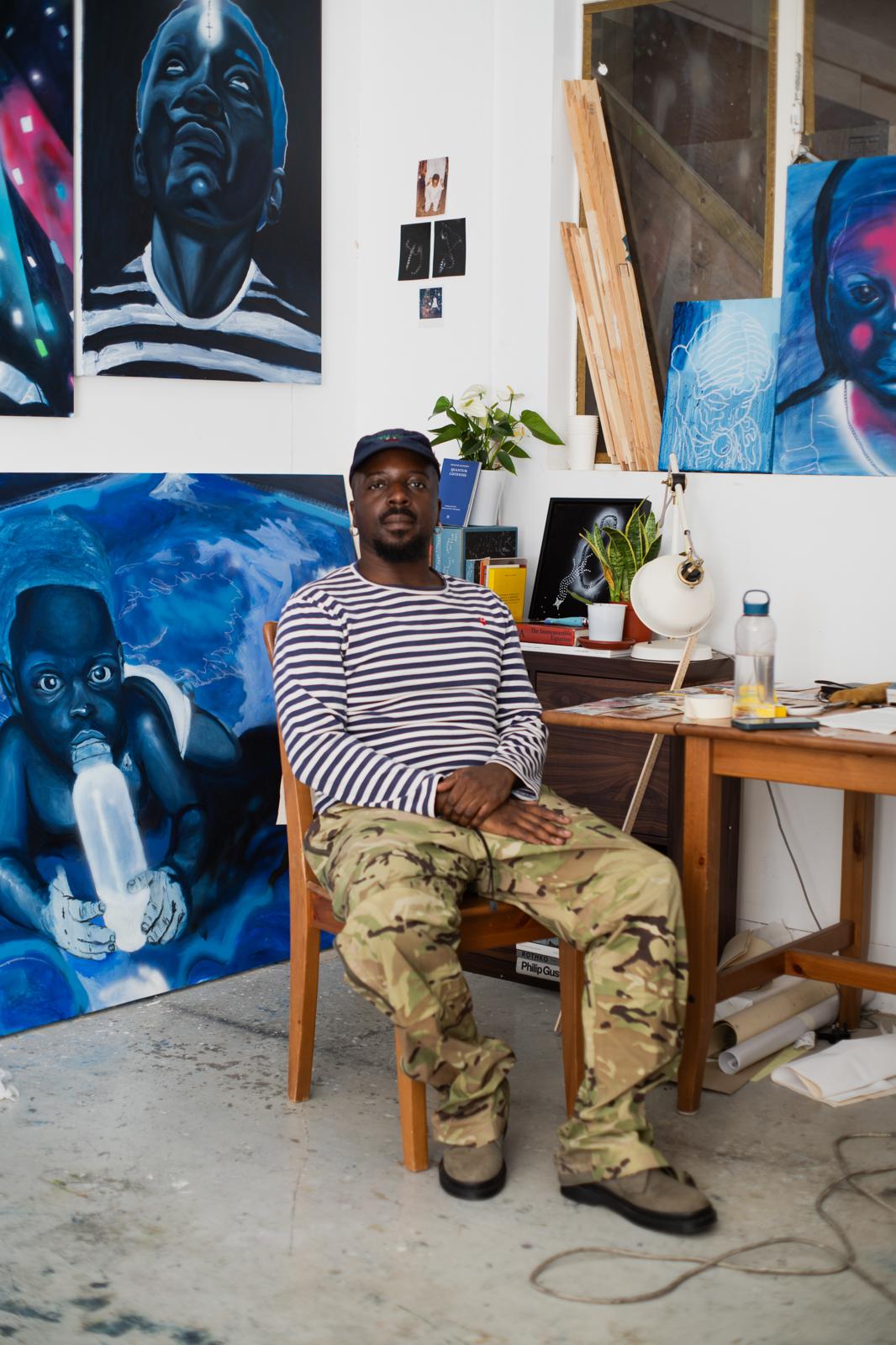
The exhibition is the result of an on-going conversation between the two artists, who have acted as sounding boards for each other throughout their careers thus far. On a surface level, they both approach paint in vastly different manners. Maiye, a trained architect, is extremely preoccupied with line, the ability to make visible the thing that delineates the form. Prior to this exhibition, the chalk outline was part of his preparatory process, borders that would eventually be filled in and rendered invisible by the moody blues and blacks that denote his portraits. There is a cartographic quality to his work at times, specifically in Expansive, by nature and Time will wait for you, where the short, tilde-like gestures form the face and hair of the young girl. The marks resemble those on a topographic map, plans that essentially allow us to see and understand the world better. But for Maiye, to think of maps is to think about the way that others have been able to dictate stories for us, and we have allowed them to go ahead unchallenged. He refers to the 1876 Brussels Geographical Conference, where King Leopold II gathered other European representatives to essentially (and arbitrarily) divide up Africa for their use.
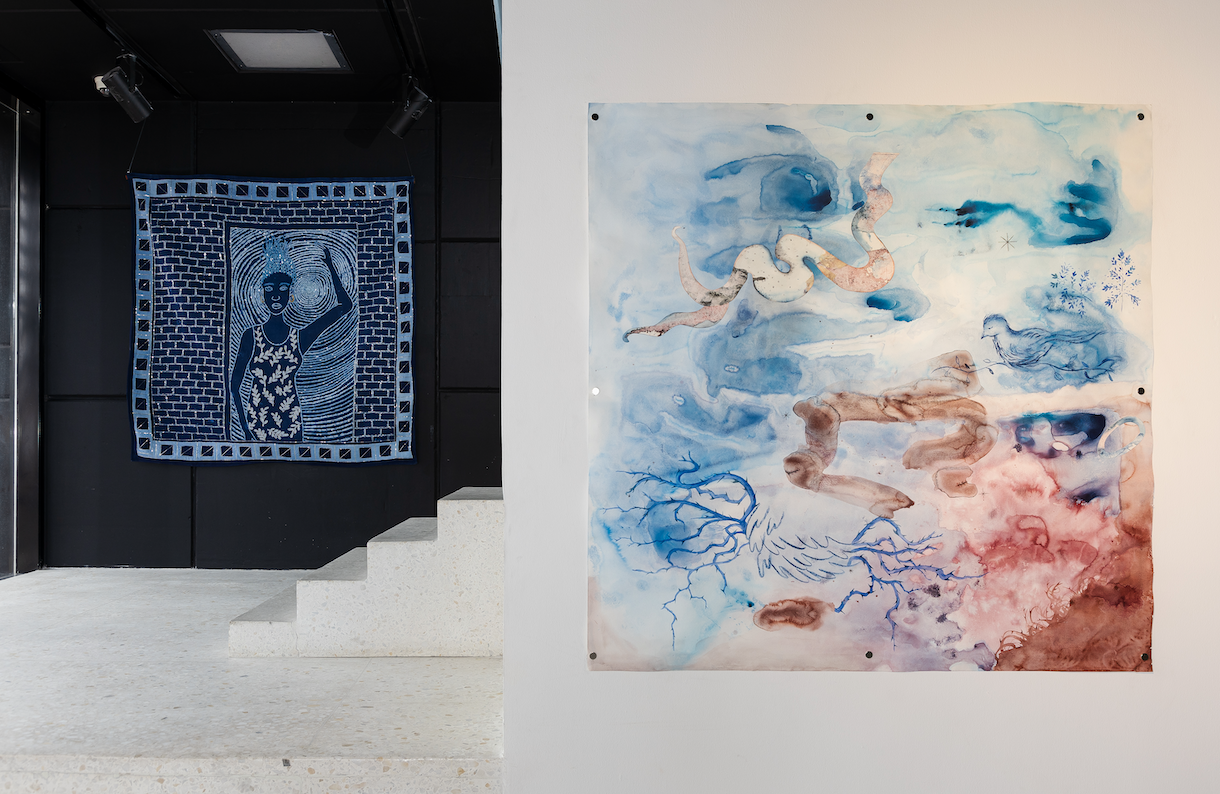
Ajani, on the other hand, aims to elucidate through opacity. There is a constant push and pull between legibility and illegibility that appears throughout the show. Her paintings serve as a challenge to the viewer; an implicit suggestion that she trusts them so wholly that she refuses to make it easy for them. In the works on show here, the lines are often blurred, like memory, and the work tends to concern itself with a rejection of the literal, and with creating atmospheric gestures that evoke overwhelming feeling before they elicit recognition. She paints from photographs or films, but is not particularly interested in achieving likeness or depicting the images in their exact forms. In what is a homecoming exhibition for Ajani, her first time exhibiting in her parents’ homeland, she is instead in pursuit of giving material both to memory and to a sense of home. Having long referenced archival family images that told stories of a life elsewhere, before her, she now creates paintings that firmly assert that that same life is one that she still implicitly understands and feels. The diaspora experience can be one of searching, trying to understand one’s place in family and collective histories. But these paintings seem to confirm that it is real; that however blurred, home is a feeling, of instant familiarity, of colour, of gathering.
Where Maiye’s chalk lines call for a more overt transparency about what things are and what they mean, Ajani responds with strokes of paint that are somehow both lyrical and staccato, but that don’t aid you in determining what you’re looking at. In Gathering II, we do see Ajani use the black outline quite noticeably, but still the forms that she is defining are languid and loose. We know we are witnessing a crowd of people and we see recognisable forms here and there; a jolt of yellow that might be somebody’s scarf, a baby pink that sits atop a chocolate brown faceless face, that might be a headwrap, but we get no other clues about the people that wear them.
The fundamental similarity between both artists is an attempt to reject stories they have been told; about themselves, about painting, about Nigeria, about Blackness, about home. There is a desire to see and do for themselves. This is where mythology comes into play. They both ask the questions: who created the myths we so readily believe? And why participate in these stories that don’t care for you when you can just create your own? When creating many of the works for the show, Ajani looked to stills from Marcel Camus’s Black Orpheus (1959), a film adaptation of the myth of Orpheus and Eurydice, set in Brazil during the carnival celebrations. It was fascinating to her, a child of Nigerians that was raised in London, to see the “présence Africaine”, the unmissable Afro-Atlantic qualities that exist from West Africa to the Caribbean to South America. So, yes, the basis of the film is a Greek myth, but to a first generation British-Nigerian, the myth is also African. She can recognise things in Brazil that she might also recognise in her parents’ old photo albums.
In this body of work, Ajani also actively encourages the viewer to change their perspective. In addition to the larger paintings that depict crowds of people, she also includes more zoomed-in portraits of historical figures, such as M.K.O Abiola and Winnie Mandela, on smaller canvases, and much more legible in their depictions. Ajani suggests that the more fact-based paintings perhaps deserve more intimacy, a closer reading. The enormity of the figures and their places in history, necessitates the viewer to approach them and sit with them. What are the myths that have been created around these figures, and what do you see now that you are face to face with them? The dance of looking at this group of works as a whole, to move back when taking in the larger crowd paintings, and to step forward when looking at the small portraits in a way, is the dance of belonging to a community, of recognising oneself in the crowd and also attempting to intimately know those that are beside us, even when they are larger than life figures.
For Maiye, who spent plenty of time researching Sun Ra and watching his film Space is The Place, he was struck by Sun Ra’s rejection of a so-called reality, and embrace of mythology as its replacement. He began to ask: “When you live in a reality that has been predetermined by someone else’s imagination, how do you reject it in a way that is authentic?”
In many ways, Call and Response is an exhibition about artistic agency. Both artists create worlds that feel right to them, and hope that through this authenticity of gesture, the work might also evoke something genuine in the viewer. The point is never to approach these works and immediately intellectually understand them, but rather to intuitively feel them. To feel the weight and familiarity of home, of history, both personal and collective. There is something stirring about watching artists learn all the rules in order to break them. A few of Maiye’s works play with perspective, and read like a photograph with multiple exposures, images layered on top of each other, a cat rendered in contrasting black chalk, lies within the white-outlined face and lap of the young girls in Expansive, by nature, Time will wait for you and Dreaming of Forever. This slight element of magical realism is an anthropomorphic nod to the supposed absurdity of Nollywood films in which humans regularly turn into animals and back again. But the artist actually forces one to ask really, how absurd is it to think that a person might turn into a cat? Is it more absurd than water turning into wine? Or Cerce turning Odysseus’s men into pigs? Everything is a system of belief, and perhaps we should hold onto ours more tightly.