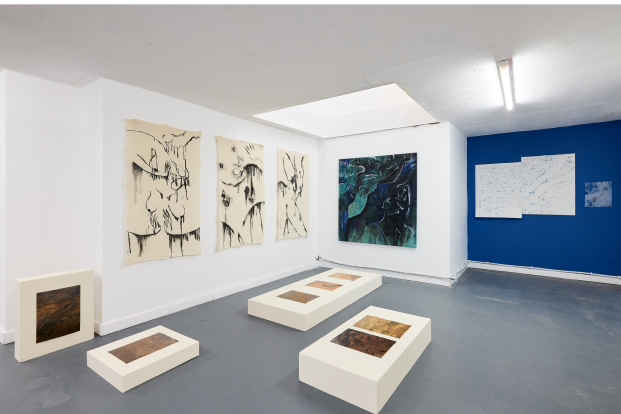
Showing for the first time as a duo, Braden Hollis (b. 1998, Los Angeles, CA) and Maya Beverly (b. 1998, Atlanta, GA), present formae. Hollis and Beverly’s friendship developed as a result of their reciprocal admiration for each other’s practices, which they discovered through their participation in a group show in London, three years ago. The following year, they showed together again, this time at Alára, during Manifold’s homecoming show in Lagos, so it feels fitting that they chose to present here again, together, and produce work within a framework established by them, allowing them to create without restraint, and experiment further with new forms, colours, and textures.
formae: a noun, the Latin plural of the word forma, meaning a form, figure, or shape, is also a verb, meaning to shape, to forge, to physically carve out a thing (or idea), and insist on its taking up of space. Again, as a verb, we might consider forma as the decision to self-fashion, forming one’s own identity, building a new world. Each of these meanings are made manifest in Hollis and Beverly’s work, where they present forms that are sinuous, angular, monumental, mountainous, stylised and abstracted, yet unified by the show’s governing condition, which is a resistance to immediate legibility, and an insistence on a slow, close looking.
In Beverly’s clay sculptures, the process of making is made visible to us. Clay’s haptic quality means that her final pieces are the result of a series of actions and responses: her sequence of coil building, carving, smoothing, braiding, glazing all keep their own visible record. The final works present clay as a material that ‘reacts’ but also carries an infinite potential within it, to become anything, or to remain itself.
Analogously, Hollis pursues this idea of material ‘building’ in her own work. In Hollis’ ideal, painting exists as a material that privileges texture, and acts sculpturally rather than purely illustratively, or as a means for illusion. What we see in her final pieces are the result of a process of layering and taking away, shifting between charcoal, acrylic, and oil paint.
A unifying feature across the figures in formae is the absence of a direct gaze, or perhaps the presence of an obscured one. Édouard Glisant’s framing of opacity as something which one has a “right” to is useful here, as the figures’ lack of time and site specificity can be read in some ways, as an insistence on keeping something to themselves. Some of Hollis’ titles are guiding, offering a narrative lens through which her paintings can be read: Pleasant Encounter, Self-assured, Gated. In particular, Self-assured – painted from an image of a couple from the 1960s – offers an emotional anchor to the intimacy of the pre-wedding moment. This title, and the subjects’ inwards postures evoke the feeling of being comforted by the presence of someone who knows you wholly.
Moreover, even in the absence of such narrative cues, Hollis’ sitters seem to emit a self-consciousness that is reminiscent of the portrait-making traditions of modern West African photography. Particularly in her Seated studies, these traditions are invoked through sartorial performance and constructed poses; they emit the assuredness and intrinsic sense of identity making that comes when one presents themselves to the world.
Beverly’s obscurity operates differently, however. She regards her subjects as celestial forms that exist as proxies for another realm. Though physically contained within the dimensions of sculpture, the objects the figures hold give light to the actual scale at which they exist. For instance, with a posture of openness, the figure in Balancing Act holds celestial objects in her hands and at her feet, suggesting that within her world, she exists as a being that is infinitely large. Likewise, the mottled texture of Caved Earth and the porous bases in Teal and Cycles act as contextual clues for the terrain Beverly’s figures might inhabit.
As we move through the exhibition, certain shapes are repeated like a refrain, conferring in a chorus of forms. Hollis’ Sitter and Singing Man, for instance, present as anthropomorphic translations of Mountain and Summit due to their compositional similarities, while Beverly’s celestial halo, moulded sometimes into orbs and other times from what look like limbs, is present across several works, imbuing them with an aura of divinity.
The perspective through which we view the bodies in Hollis and Beverly’s artworks oscillates. They appear to us with a tight crop, walking away, recessing into the background, submerged. And yet amidst this diversity, both artists have turned to the reclining figure, a form that recurs across art history from sculpture to painting, in the work of Henry Moore, and Elizabeth Catlett (among numerous other artists), in the pre-Colombian Chacmool and archetypically in painting, through the image of a lounging Venus.
For Beverly, we see this lounging pose in Reclining Figure appear as a result of her thinking through what it could look like to endow her figures with a sense of mobility or stillness. Conversely, Hollis’ lounging pose came about in response to seeing a posed image of the model Ranya Mordanova, and the colours she used in her studies of seated figures. Still,
it is difficult to separate the works from the visual traditions they inherit, even if unintentionally so, as they inevitably exist in lineage with artists’ employment of the reclining figure as a vehicle to explore ideas of sensuality, beauty, and rest. Equally, Beverly’s Under Terra may conjure sentiments of familiarity to a Nigerian audience, due to its formal similarities to the Oba of Benin bust sculpture that is posthumously commissioned to commemorate the succession of kings.
The associations and readings that have emerged throughout this essay are of course, suggestions, but they are useful to explore when considering form and its associated meanings as an ongoing relation between pairs: artist and material, object and audience, object and histories. Returning to Glissant’s writing about opacity and one’s right to difference, he expressed that “the opaque is not the obscure”, but rather, “that which cannot be reduced, …the most perennial guarantee for confluence”. This framing, of meaning as endlessly unfolding is felt tangibly in formae, throughout which Beverly and Hollis present works that insist on duration because they are not immediately legible. Through a process of looking to and away, in proximity and from a distance, the works cumulatively reveal themselves through subtle visual tropes of gesture, and form, triggering the references we subconsciously bring to them, but which nevertheless structure the ways in which we see and recognise.