It’s Sunday in Lagos. You’re stuck in traffic. As you consider lunch plans, you glimpse a blur of white out the corner of your eye. And then another. Until a sea of white caps and gowns process past – members of the white garment church, more broadly known as Aladura. The lights change, and your thoughts turn back to the road.
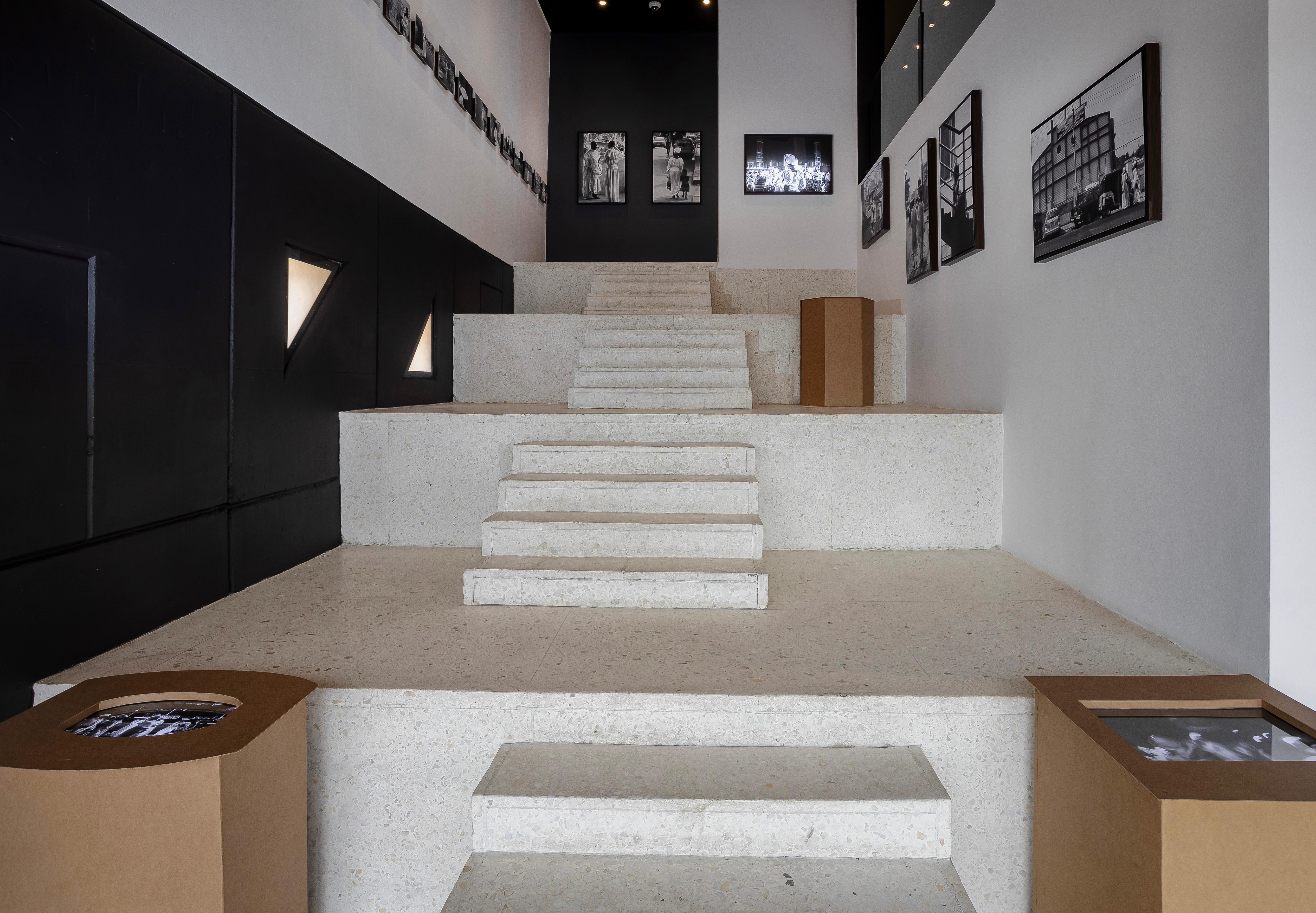
But for photographer and artist Stephen Tayo, this snapshot of everyday life is worth a second look. His ongoing series WHAT COMES TO MIND WHEN YOU SEE THE GARMENT? takes the position of an intimate observer to the movements and motions of a distinctive community. The Aladura movement is one surrounded by myth and misunderstanding, due, in part, to their practices being deemed “un-Christian”. Their lengthy services, sometimes as long as 7 hours, are characterised by fervent prayer for divine healing and an affinity with bodies of water. Despite nominally being a branch of Pentecostalism, this unconventional approach has drawn comparisons to traditional Yoruba religion, and thus accusations of witchcraft and occultism. As a Christian himself, Tayo felt at odds with the narrative he’d inherited about the denomination from his parents and society more broadly. Surely a belief in God should mean being unified in a belief of something greater than ourselves?
A former student of philosophy at University of Lagos, he began an inquiry into the subconscious associations triggered by the sight of the white garments in an effort to create a more balanced picture. Over 5 years, Tayo has documented thousands of moments of worship and gathering across Lagos, Ibadan and Benin Republic. His monochromatic lens collapses locations, time and space, focussing instead on the presentation of faith as both personal conviction and public identity. He refuses to view the church members as a monolith, a perspective that feeds into broader conversation about tolerance and individuality within religious identities.
Exhibited for the first time in Nigeria, his message is highly relevant against a backdrop of simmering social and ethnic tensions. For Tayo, the second look calls for curiosity. It calls for a multiplicity of meanings, for a diversity in ways of being, for a willingness to see beyond what’s presented on first viewing.
His methodology can be used to critically engage with stories we tell ourselves about the “other” on both a personal and societal level. Can we untangle ourselves from inherited narratives when we choose to slow down, to observe, and to exist in communion with one another?
Inherited Narratives, Contested Realities
What better medium than photography to explore these inherited narratives. To understand the negative reception to Aldura practices, we must first understand how colonial narratives perpetuated through photography have equated a proximity to the indigenous as a proximity to backwardness.
Contrary to its claim to objective truth, the photograph has long been established to be a site of contested realities, a mirror and view into the complicated web of social relations that underpin the everyday. To Sontag, the photographer is “not simply the person who records the past, but the one who invents it” (1977:67). Early conceptions of the camera viewed it as a tool to make direct imprints of reality. The inventor of the first camera, Daguerre, claimed it as a chemical reaction that gave nature "the power to reproduce herself" (McQuire, 1997:13). In actuality, the camera was key in the construction of and reproduction of a colonial reality that depicted racialised people and places as inferior "others".
This is because in the Western understanding, to know something is to have power over it. In the construction of power alongside bodies of knowledge, photography’s claim to truth supported “relations of domination and submission” (Cesaire, 1972:15) by claiming them to be reality. Thus, photography supported colonial expansion by naturalising it. If an image of a poor, suffering "uncivilised savage" was taken by an object that made direct "imprints" of nature, then it was uncontestably true. As a result, the “civilising mission” of colonialists and associated institutions of control were not only advisable, but necessary. Such is the “kinship of photography with violence” (Cole, 2019). By wielding a camera, colonists asserted their right to subjugate a land and its peoples by making claim to a singular reality of Western ideological and moral supremacy.
Central to these ideological institutions was the church. Missionary churches arrived in Nigeria as civilising institutions that used religious, educational and political control to reshape societies to the extent that "civilised" came to mean, in practice, Christian. The colonial mission-education system recast Yoruba traditional religion, Ifa included, as superstition. Converts who passed through that system became its most effective enforcers, as the “watched learned to watch themselves” (Foucault, 1977). This self-policing extended colonial control as subjects internalized colonial hierarchies of value and enforced it within their own communities. Thus, in the same way, religion was weaponised as a tool of imperial power to naturalise colonial rule.
Indeed, much of the initial aversion to the Aladura churches was the “psychological fear of belonging to a church that was "not recognized" by the government because it was not under "proper control" (Adogame, 2004). Decades of defining indigenous religion as backward are pitted against a version of Christianity that refuses to fully discard it. Although the Aladura themselves reject the idea of a closeness to “pagan” traditional religion, (the white garments represent spiritual purity) they retained the belief in “ritual action” like dreams, visions, and prophetic revelations in prevailing against evil. Aladura practices instead, represent a “new version of Christianity” that constitutes a “distinctive synthesis of Yoruba and Christian beliefs and practices” (Ray, 1993). Aladura translates from Yoruba as “praying people”, apt in reflecting their emergence during a time of multiple social and political crises both at home and abroad. The global shockwaves of The Great Depression and World War II were felt by Nigerians through the tightening fist of colonial powers, who sought to offset their losses by extracting more from the continent. Stock market crashes compounded by increased taxation, drought, skyrocketing prices and an influenza outbreak led to the creation of prayer groups to navigate “a cosmos that is alive with invisible powers, especially malevolent ones” (Ray 1993:268)
The 1920s and 30s were also characterised by increasing anti-colonial sentiment marked by moments like the Aba Women’s Revolt or the birth of the West African Pilot. It was this anti-colonial sentiment that also drew much of the early membership of Aladura churches from mission churches. In the 1960s alone, 66 percent of converts into the C&S branches in Ibadan were from the Anglican Church. This also marked a demographic shift, its initial social demographic were those unwelcomed by mainstream churches, which were populated with the elite and the educated. The Aladura church was not only a place of worship but a rehearsal space for a different kind of social imagination, one in which the educated elite did not hold a monopoly on spiritual authority, and where those excluded from mission respectability could make claim to their own convictions.
Capturing the Aladura in Lagos, Ibadan, Ado Ekiti, Ikere Ekiti and Benin Republic, Tayo’s series subtly tracks key locations in the founding of the church’s different denominations. Reading against this history, the contemporary suspicions of Aladura worship are inherited optics. The same visual logic of colonial worldbuilding reads a procession of white garments with superstition and disdain. Tayo's camera works against that inheritance by refusing to treat the Aladura as spectacle. There is no single decisive image, no dramatised shot of ecstatic worship, only the accumulated, quiet evidence of people at worship, week after week.
Ways of Seeing: Observation as Social Methodology
Berger recognises that in “ways of seeing…we never look just at one thing; we are always looking at the relation between things and ourselves” (1972:9), Therefore, to take a second look is to intentionally choose to visualise and interrogate our relationship to the world.
In this way, Tayo’s documentary work is a practice of visibility. Tayo’s commitment to seeing beyond has been primarily expressed through an interest in the relationship between people and urban streetscapes. How people move through the streets, and how within this relative anonymity, fashion becomes an important signifier of identity, personality, culture and community. Much of his work has been inspired by the stylised poses and self-fashioning of 60s and 50s West African studio portraiture. This contributes to a counter-narrative in which the colonial origins of photographic techniques in the definition of the African subject is twisted postcolonially as a means of self-definition. Mustafa (2005) refers to this shift in control over the photographic narrative as "mastering the conventions of civilisation" (232). The stylised self within the photograph is a form of cultural capital and a construction ground for ideological development. The way the body is posed, clothed and photographed speak to how postcolonial identities and ideologies of self-determination and liberation are simultaneously crafted. An attention to the white garments of the Aladura church is thus an extension of this continued observation of self-fashioning within his practice.
However, in a departure from his practice, Tayo has maintained a distance from his subjects. The usual self-aware directness of his participants is absent, and instead, worshippers appear wholly absorbed in the intricacies of their everyday life. Conversely, it's in this observed distance that Tayo is able to get even closer to his subjects by exploring alternative ways of knowing and understanding. Glissant argues for the right to opacity and rejection of legibility. The desire to know a thing completely is deeply linked to Western understandings of knowledge and power. However, true understanding does not require total illumination (Glissant, 1997). Allowing others to remain fundamentally unknowable is a way to respect their complex humanity, resisting reduction and categorization. In the blurred movement of his long exposure images, we become patient observers on the periphery. We move instead “at the speed of trust” (brown, 2017), gaining new understanding through total immersion in other worlds and ways of living.
In this in-between, unknowable space, Tayo instead finds himself. He describes a shift toward a more intuitive, "in-motion" process where he is not trying to be definitive, but rather seeing where the work leads him. He values this as a "return to self" and a way to deepen his practice. This is because, fundamentally, he has grown weary of speaking the language of the industry. One that is almost exclusively concerned with pressure, price points and marketability. Instead, he’s found himself drawn to improving his fluency in the visual language of everyday life.
This leads him to question how a community can be represented by more than just faces or fabrics but through an intimate understanding of inhabited spaces. How can a person be known through the communion bowl they brush past every service, or the backlit cross they see before closing their eyes to pray. Tayo thus pays closer attention to the material and spatial language of the church, and the intimacy of his portraiture is felt more through the exhibition design. The images and their receptacles are portals into their reality, made concrete through material worldbuilding. Another key character within his series is the cityscape. Contrary to seaside depictions of the Aladura in Nigeria from photographers like Akinbode Akinbiyi and Andrew Dosunmu, Tayo’s images are contained to the urban environment. The cities he visits are keenly attuned to the rhythms and rituals of religious life. In a city with a lack of formal infrastructure, the roadside acts as an extension of life that blurs private and public realms. Barber shops, bakeries, banks, prayer mats and makeshift church pews – a place to eat, sleep, gather and worship. That the church occupies it so naturally is less a sign of informality than of resilience, of communities long practised in making sacred what the city offers rather than waiting for what it withholds.
Faith and Resilience in Contemporary Nigeria
The Aladura movement emerged during a moment of crisis that mirrors contemporary realities. Uncertainty, the deep-seated feeling that tomorrow is not promised, is no stranger to the average Nigerian. The last year alone has seen flooding, fuel shortages, food insecurity, insurgency threats, ethnic and religious tension, and an education system in collapse. In a country with over 60% of its population under 30, there is a pervasive sense of disillusionment and distrust. For many, faith is not just a respite from the storm, but their most reliable form of collective power. However different their practices may be, the one thing that unites churches, mosques and other religious institutions in Nigeria is the shining beacon faith becomes in hard times. These institutions are social infrastructure where there otherwise is none. Centres of community, solidarity and mutual aid.
Thus, under these conditions, to take a second look is to choose to extend kinship, tolerance and understanding. To sustain belief in the shared humanity of others, and see beyond inherited narratives.
For Tayo, who grew up inside these inherited tensions and who counts family members in the congregation of the Aladura, the work is personal in ways that a purely documentary impulse cannot account for. To photograph a misunderstood community across five years is to keep returning, to keep looking, to resist the resolution that a single decisive image would offer. In doing so, he models the very practice of the second look his series asks of us, and stays grounded in the relationships and spirit of openness that keep the work ongoing. Ultimately, by photographing a community of believers, Tayo finds renewed reasons to believe in himself, his process and his direction.
–– Fikayo Adebajo
Bibliography
Adogame, Afe. “Engaging the Rhetoric of Spiritual Warfare: The Public Face of Aladura in Diaspora.” Journal of Religion in Africa 34, no. 4 (2004): 493–522.
Berger, John. Ways of Seeing. London: British Broadcasting Corporation and Penguin Books, 1972.
brown, adrienne maree. Emergent Strategy: Shaping Change, Shaping Worlds. AK Press, 2017, p. 41.
Césaire, Aimé. Discourse on Colonialism. Translated by Joan Pinkham. New York: Monthly Review Press, 1972.
Cole, Teju. "When the Camera Was a Weapon of Imperialism. (And When It Still Is.)" New York Times Magazine, 6 February 2019.
Fanon, Frantz. Black Skin, White Masks (Peau noire, masques blancs). Paris: Éditions du Seuil, 1952. English translation by Charles Lam Markmann. New York: Grove Press, 1967.
Foucault, Michel. Discipline and Punish: The Birth of the Prison (Surveiller et Punir). Translated by Alan Sheridan. New York: Pantheon Books, 1977.
Glissant, Édouard. Poetics of Relation (Poétique de la Relation). Translated by Betsy Wing. Ann Arbor: University of Michigan Press, 1997
McQuire, Scott. Visions of Modernity: Representation, Memory, Time and Space in the Age of the Camera. London: SAGE Publications, 1997.
Mustafa, Hudita Nura. "Portraits of Modernity: Fashioning Selves in Dakarois Popular Photography." Politique africaine, No. 100, 2005/4: 229–247.
Ray, Benjamin C. “Aladura Christianity: A Yoruba Religion.” Journal of Religion in Africa 23, no. 3 (1993): 266–91.
Sontag, Susan. On Photography. London: Penguin Books, 1977.