

Tell me about your work
I was really feeling nervous because it's really changing right now. So originally, I would have said, it's about the narrative surrounding black people in a way that encompasses the variety. And just creating stories that feel true and interesting to me. And that was very much me looking outwards, and observing things and seeing certain behaviours and patterns, and then observing them, internalising them and then reacting to them in a painting. And the paintings were mappings of my ideas and thoughts to do with these moments, and sometimes excavating a particular history about football, for example.
So I was really into Justin Fashanu, I don’t know if you know him.
Yeah, the footballer
I think when I first got into that, it was because the Euros were on. It was June 2021. I was noticing how there were these LGBTQ flags, but there are no gay footballers that I know. I couldn’t name one. So I was thinking, has there ever been one? And then I found him. And so I work like that. I see something, I recognise something, then I work backwards. And then I use the painting to figure it out, exploring it in this way that feels like I can connect and maybe other people could also connect. It's always about thinking bigger and broader. But now it's more like I'm looking inwards, which I guess everyone does at one point. I'm starting to analyse why I was looking at those particular things and how they relate to me and my identity. And not even me questioning my gender identity, but just looking at myself in this way that you don't do until you get to a certain age. I feel like I spent so much time going, going, observing, observing and taking it in. And then you’re like, wait, you know? So that's where I'm at now. And that's why I feel like the work has changed a lot. And the pace has slowed down because to look at yourself and think about yourself is so long (laughs). So, yeah, that’s what I’m doing now, looking at myself, looking at my own histories and how they relate to how I see the world now.
Do you think that the switch from a more observational method to a more introspective perspective has changed the style of your painting? And if so, how?
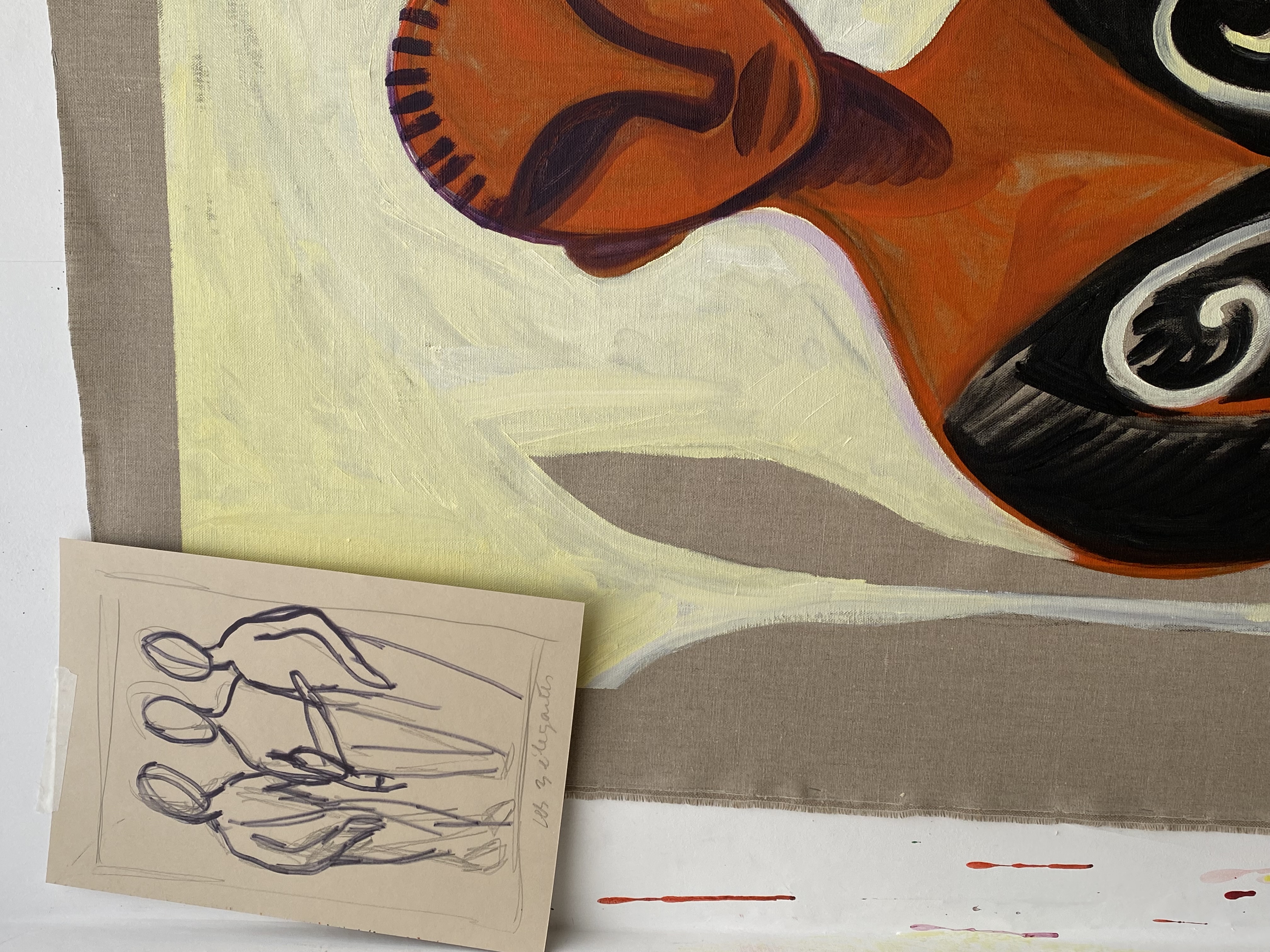
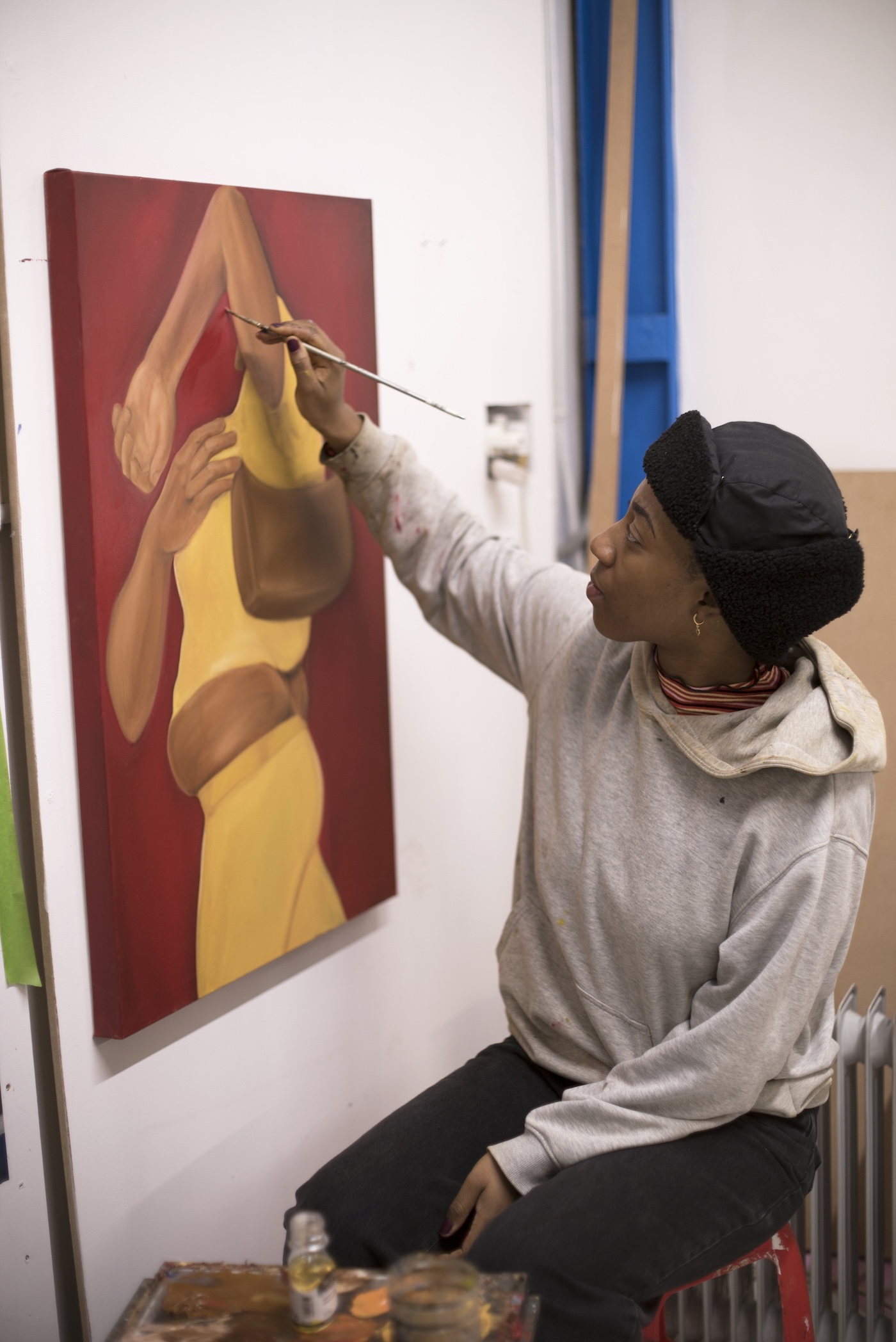
I think it has. Before, all my paintings were about the figure, the physicality of the body. Even in the size of the painting I would always relate them to how they would feel with a person standing next to it. It was always about the body. And it still continues to be, I still make figurative paintings, but I'm looking at animals more, and looking at landscapes more, and building out the narrative. A lot of the time before it was a figure in a nondescript abstract space. And now, I’ve created a world for the figure. So in terms of myself, I'm placing myself in a narrative in a sense. And in my work it allows me to root the ideas, root the figures and root the story.
Even the work that you showed in Manifold Deluxe, it is kind of like a zoomed in moment, right? There's no real context.
Yeah. And I’m starting to understand myself, and to understand myself in context. So that's why everything is starting to zoom out. I still do those crops, but I haven't done one in a while. I'm more interested in creating a scene.
You’re obviously a multidisciplinary artist and we always speak about film, writing, photography painting. How do you see all of these things within your practice?
I'm a person that gets bored. Not even bored, but I get a lot of energy. And it needs to go somewhere. The paintings at the moment are requiring slower energy. So I’m like where can I turn my energy? Okay, let's go to the writing. The writing can be kind of furious. Then I have this other energy where I want to edit and be very specific. And then I'm now into etching. So I think I have all these opposing energies and it’s just about finding spaces to put them because I just need to make all the time. I just like to make things and I have all these ideas. And I just need to see them. I think I really look at the world a lot and I internalise a lot of what's happening, and then I need to get it out. Otherwise, you go crazy, you know. This is gonna sound so lame (laughs) but I think I'm just very sensitive to everything that goes on. And so when I take it all in, I have to figure out where to put it.
I think of the work you showed in Manifold as an interactive work. I was just wondering about the new direction you’re going in, and how you feel about putting more introspective and internal works into the world? How do you reconcile something that feels very personal and introspective with an audience?
I wish that both can be true; you can make internal work that people can interact with. I still want to do stuff like the work in Manifold, where people can interact, and they can engage, because I think this is where it's at, when anyone can go into a gallery and connect. With the hand one, it was kind of from the football research, and I was also looking at the history of voguing and hand movements. There's a stereotype of gay guys, that they had limp wrists and I was kind of breaking down the history and figuring out that it's actually more of a class thing to do with them not working. And they would say they're gay. But back in the day gay was not like homosexual. They were just dandies. They didn’t work. They were bohemian. They were like living a certain lifestyle. So I was thinking about how things can be taken out of context and new histories can be created. The idea that a hand movement can be gay, and then you're like, well, is it gay? If you look at something minutely, then you'll realise that it's just quite stupid.
What does Manifold mean to you?
I was really excited when we first started talking. I was looking for something like that. I think it's like the start. It's the beginning, point one, and then all these things can come from it.
