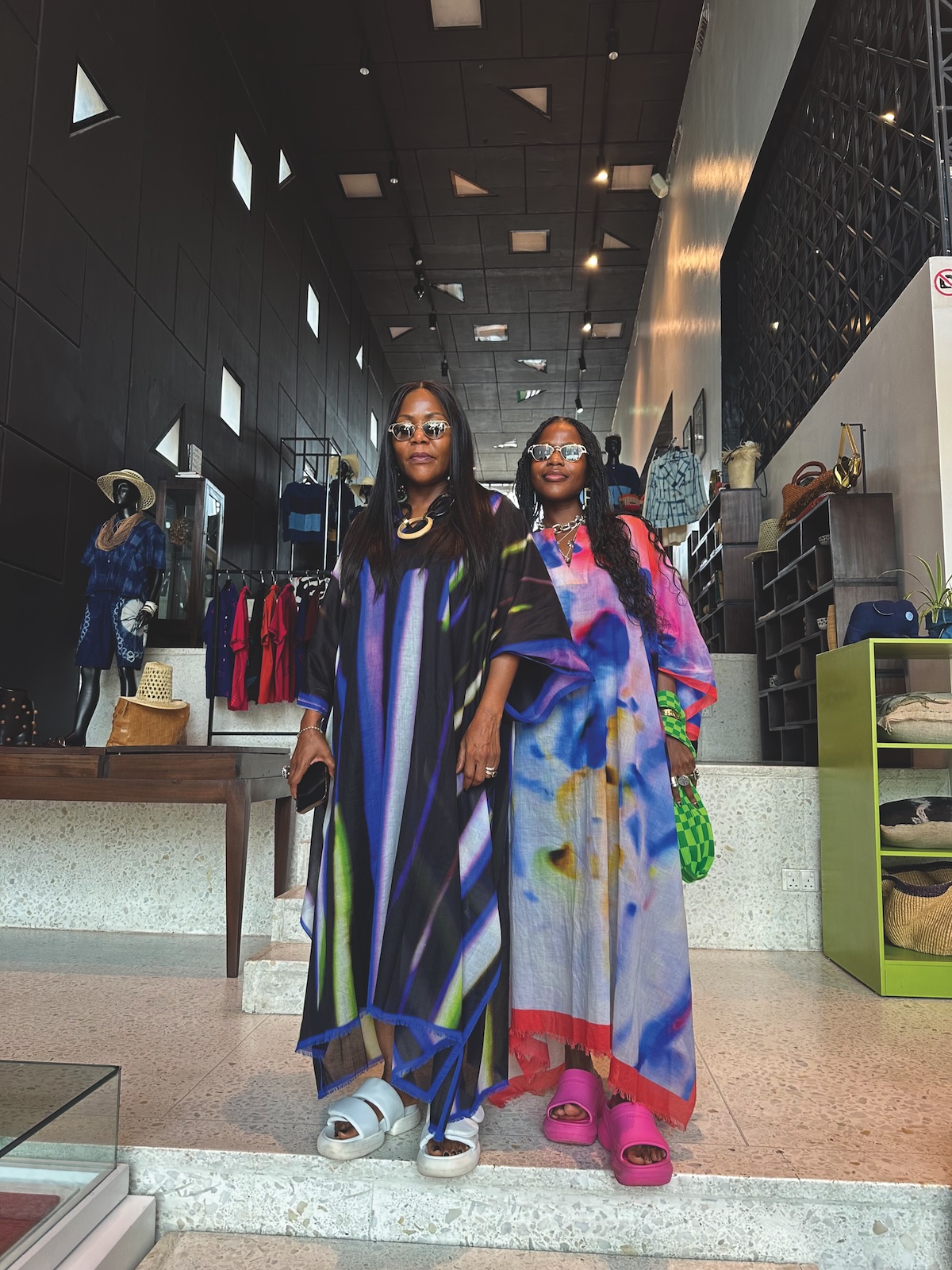

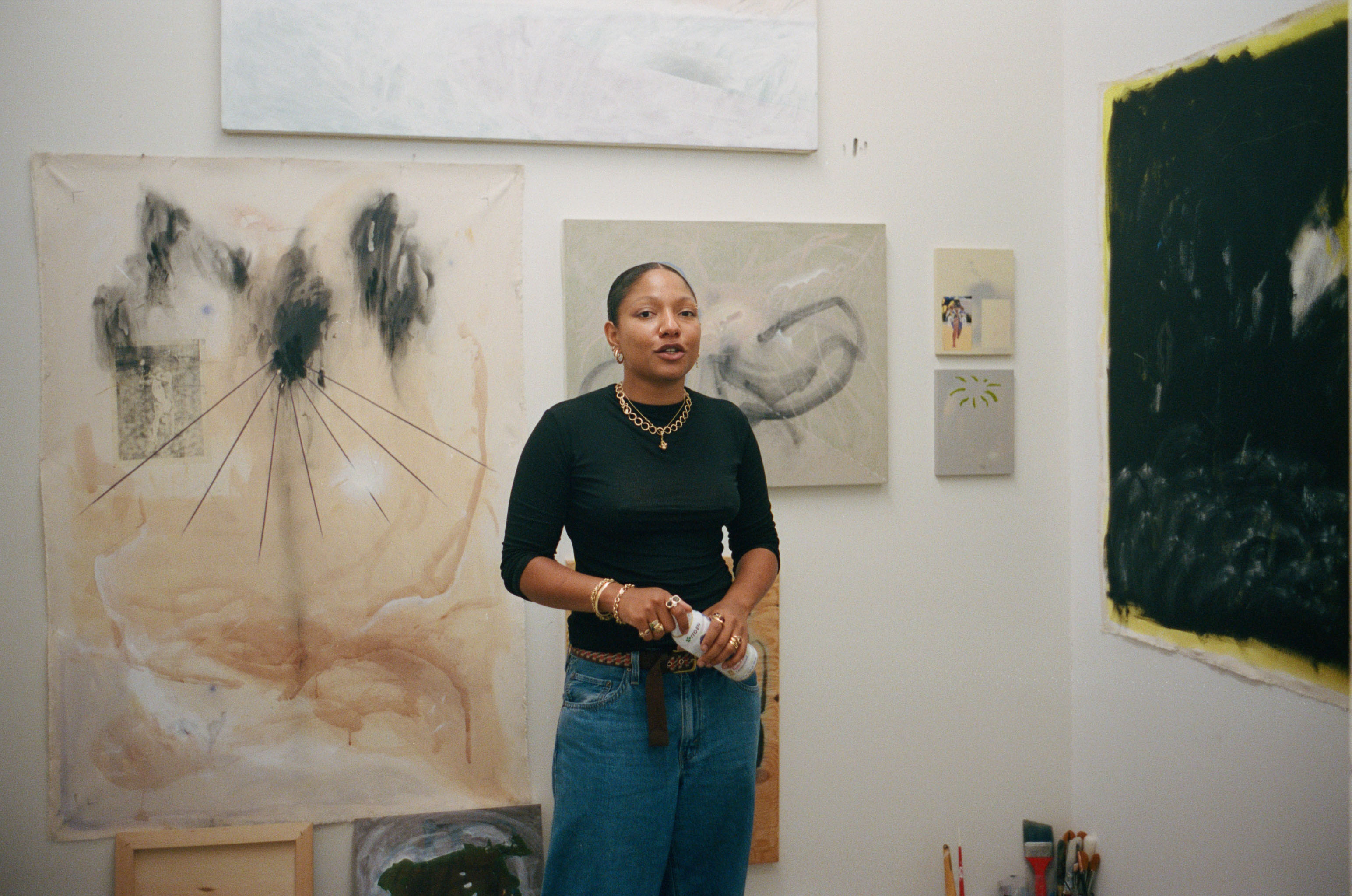
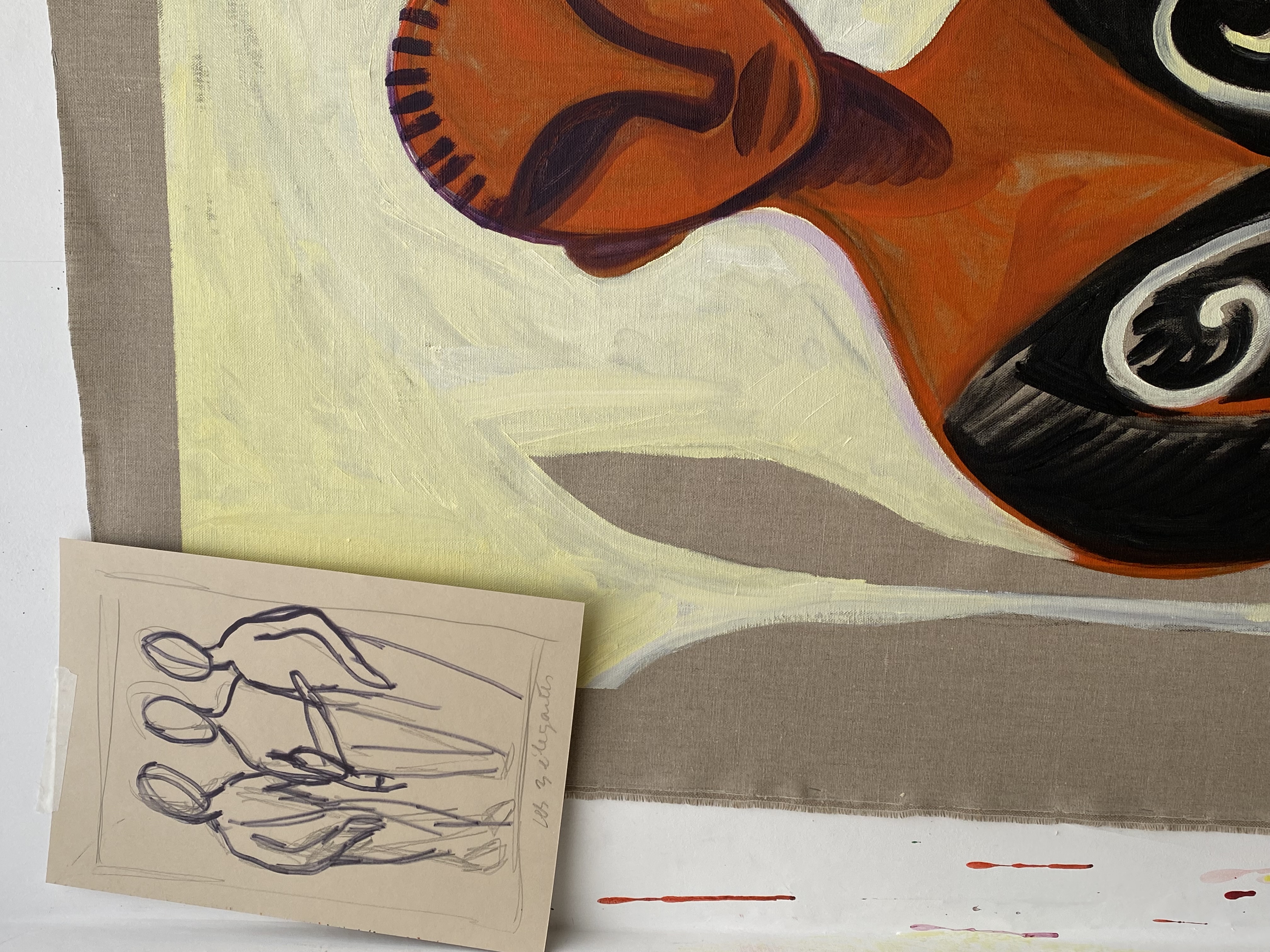

Reni Folawiyo
Hello Faridah Folawiyo, it’s nice to be here with you.
Faridah Folawiyo
Hello Reni Folawiyo
[Both laugh]
It’s also nice.
R
I’m laughing so much. I was going to pretend– half pretend– like we’re not as familiar as we are. Some of these questions I think I know the answers to but I’m going to act like I don’t or sometimes I might act like I do. So it’s going to be quite random if that’s ok.
F
That’s fine.
R
Ya so I mean…I would actually like to start at the beginning… which is kind of like… Uh just tell me in general terms a little bit about yourself. Just you. Faridah. Tell me about Faridah.
F
Umm ok. I’m Faridah
[Both laugh]
R
Hi Faridah
F
You mean generally or with regards to my work or just…
R
Generally because I think we’re going to speak about your work going forward. I think about you might be an interesting starting point.
F
I feel like when you’ve asked me this before I don’t really know what to say. I am a human being trying to make sense of the world. I am a daughter, a friend,
[Both laugh]
I’m currently trying to understand and I guess think through the impact that my work and my being can have on the world. I love to learn, I love to travel, I love to improve, I like to get better at things. I love the people around me, I feel very lucky. I’m currently trying to be more mindful, that’s my next goal in life. Um ya. I don’t know if that answered..
R
Yes, thank you for that I mean, when you said daughter and a friend I thought it’d be interesting because that could be read in a very basic way. So knowing you I don’t read that in a basic way. I read it that you say that because there’s an essence to being a daughter and an essence to being a friend that you embody and that you kind of like, do so easily and wonderfully. So when you speak quite loosely about these things. You know, I think sometimes knowing you, I think, and also knowing your work to a larger degree, everything you said makes sense. Being the essence of being a daughter, friend, and a real lover of people and life. I find that interesting and intriguing about you.
F
I am a lover of people and life
R
Ok so, let’s get into the nitty gritty of things. So why do you do what you do? Why the art industry? There are two questions: why do you do what you do and why do you do it in the art industry.
F
I think that my goals have always been quite big. And I think that when I think through things I obviously get that from my parents. But I think I always had very lofty goals. Which is like- I’m very obsessed with black people and our potential and our excellence and our independence so to speak and trying to do something that can really highlight that, improve that, build on that. So I think that kind of the essence of the work is creating something for black people for the future, for now. And why in the art world? That I don’t know, and I don’t know that… I’ll probably leave the art world soon. Cause I feel like..
R
Sorry? That’s a shock.
F
I’m always threatening to retire. But ya, I don’t know that what I do needs to be limited to the art world. It’s just it’s an area that I also really love and that I studied– and I do better in areas that I studied because I feel more confident. As we’re going to see in this show and in all the shows there’s so many incredible black artists and it feels like a great privilege to be able to work with them, and then also to be able to connect them to black collectors. So ya it’s just an industry that makes sense right now. I’m not sure that I feel that strongly about it right now.
R
So if it wasn’t the art world, what other world could it be?
F
That’s a good question. I don’t know because I haven’t studied anything else. But I feel like when I say that I guess I mean that the goal itself is big and it’s broad and it could encompass so many different things. But I feel most comfortable in the art world, it’s what I know, it’s what I’ve studied, it’s what I think about critically so it’s just easier for me, but, maybe there’s a pivot somewhere, I don’t know.
R
Well I’m learning about that pivot now. But yeah you did talk about the fact that you’re doing what you studied and you did mention your family influence but can you expand a little bit more on how you think your family has influenced your path, you know, to where we are today. I think that I would like that in two ways: your family as well as your studies– even though you touched on that already.
F
It’s really funny because whenever people ask me if I work with you and I’m like not officially but yeah. And it’s like we all kind of work together in our family in a way that I think people don’t really understand. It’s a little bit weird. But I think that both you and dad have a very, have always had a very pan-African approach. Like it was always bigger than Nigeria. It’s always been, you guys travelled a lot within Africa, you did a lot within Africa. So I think there’s that aspect of it which is like I think I grew up with the pan-African mindset that a lot of people maybe didn’t. And I think that the other thing is that when, I remember when I did the first Manifold and it was so hard for me to, I was trying to get sponsorship. And I kept making these decks and I was like, I don’t know how to make a deck to really express what I’m trying to do because if you don’t know me you won’t get it. And if you haven’t seen me do it you won’t get it. And I think that people were kind of surprised by the scale of it for my first show. And for me it just felt really really normal because I’ve watched you do things that are really large scale. So when you were like I’m doing a concept store, I don’t think people really understood what it was going to be. The scale of it, both the actual size of it and also the kind of ideas behind it. So I think there’s like within our family we’ve normalised this large scale, high quality excellence thing. That for me, that’s the only level that I know how to strive towards. If that makes sense. So I think that the family influence is just kind of in that like not doing things on a small scale. And I think that even with this show, like, this is obviously the biggest show I’ve done yet and it’s in Lagos. And there is something from your work that also makes sense to me which is like Lagos deserves the very best. And I think that’s what you’ve been doing for years and years and years and years. And then studies wise– wait what was the question, how did it influence my work?
R
Yes, how did it influence where you are today, what you studied. And when we touched on it before, when you said, well this is what I studied so this is what I’m doing. But maybe a little bit more in depth, like what’s the depth of it? The depth of what you might have learned during your studies that has affected the direction that you have taken.
F
So I think that I was really lucky in the sense that I didn’t study history of art in my undergrad, I studied Middle Eastern studies but because I was in America I took a lot of history of art classes and I wrote what was kind of like a hybrid history of art-middle eastern studies thesis. So I think I was lucky in the sense that I– the first ever history of art class I took was with a Nigerian professor, which is Chika (Okeke-Agulu). And it was about the Harlem Renaissance and the Black Arts Movement. So it was just about Black Art. So my entry into art history it was just like marvellous, I was marvelling at the theory, at the art– at all of it. It was kind of the most incredible thing to enter in that way. Like the Harlem Renaissance is one of the most amazing eras ever. So to be able to enter the art historical canon from there and not from the other old stuff that’s important but like that doesn’t hit the same way, I think was really great. So I kind of had this very magical, kind of entry into it I would say. And then, ever since then I’ve always worked and written thinking about Black art and Black artists. I took the European classes, which I also loved as well and they also helped me. But I think that entering in that way meant that I was able to centre Black art in a way and the European stuff was on the periphery. Whereas I think that other art history students learn to centre the European stuff and everything else is in the periphery, if that makes sense.
R
I think it’s super interesting that you say that because I remember when you did say you wanted to study Middle Eastern studies and I was like ok, it kind of suits her because she likes languages, she has tentacles in different areas and of course I think also has literature and history, has bits of everything. So in terms of what suited you personality wise, I wasn’t really surprised that you chose that. But what is super interesting is that you’ve talked about how your professor, and in particular subjects around the Harlem Renaissance, helped you to sort of [jump? - 12:40] and use something quite intimate. But I also think that the opportunity to have that in contrast to European art, to the Middle Eastern sort of region as well kind of, you know, began to form someone who already had a very solid background in Pan Africanism and what the new world could possibly look like. So I love the fact that we’re talking about how your journey evolved in this organised and exciting way.
F
It’s very global
R
Sorry?
F
It’s very global
R
Yes, yes very much so. So can you tell me first of all, tell me about FF. We’ll talk about you journey. And then you decide that ok I want to do Manifold I and then I’m going to have something for the FF Projects and we’re going to do also other projects within that. Can you tell me about that and the genesis of that.
F
So I think that, I am a very considered person, I would say, but there’s also an element of sometimes I kind of just do things and figure them out as I go along. And I think with FF like I had sort of ideas of what it could be and I was working on it, working on it, working on it for years, like from covid, just trying to kind of like refine it. And then I had the impulse to do Manifold and I think when I had the impulse to do Manifold, FF had to take shape very quickly, even though it had been simmering under for a long time. So I think that it is purposely vague (what it really is.) I don’t want to call myself a gallery because I don’t believe that galleries, I don’t think a gallery could encompass what I’m trying to do and I don’t necessarily understand or know what the significance of galleries right now is. It is not purely curatorial because I really really believe in the commercial part of art. And I think when I first started I didn’t and I’m now starting to understand the power of the commercial part, especially when it comes to Black artists and Black collectors. I mean, we’re working on publications right now so that’s also kind of encompassing publishing. We don’t really represent any artists. So it’s like this very like free-flowing, hybrid structure at the moment that I’m figuring out as I go along, and figuring out, kind of adding things that I think make sense and like, getting rid of things that I don’t think make sense. So I don’t know how to define it currently. Calling it a nomadic curatorial platform I think that’s the buzz-phrase currently.
R
Ok. Nomadic curatorial platform. That sounds nice. What about Manifold then? How did the first Manifold come about?
F
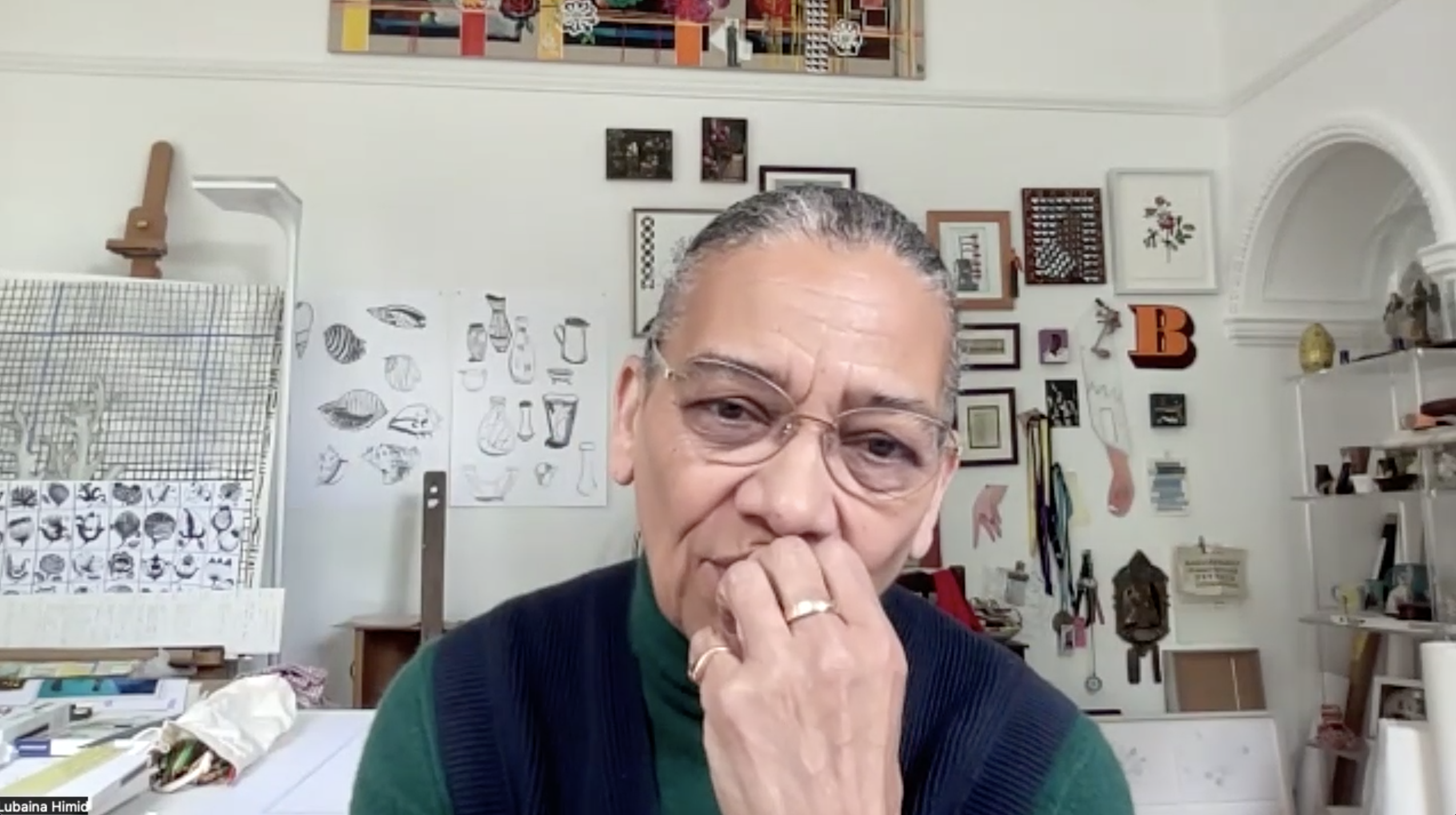
So the first Manifold came about. So I had left the job I was working in in November of 2021 and I wanted to freelance for the year of 2022. So that meant reaching out to galleries, speaking to galleries, institutions, trying to figure out if I could do shows with them and I had two shows in the works in 2022 and they both fell apart quite spectacularly for different reasons but just like the way in which I felt speaking to the people that I was working with and just like some of their behaviour, some of the– it was just kind of shitty. And, there was kind of no real reason why I couldn’t do it myself. So I think that was really the thing. It was like ok I’m working with all these people because I’m trying to legitimise myself and my practice but why can’t I do that myself? And then, I’m obviously always talking to artists, going to shows and things like that. So I already had in mind that I really wanted to do a show of women artists. And that was already in the back of my mind and then I just kind of step by step started trying to figure it out. Oh like what would this take? What space could it be in? How do I find a space in London? And things like that and then step by step it just kind of started happening. I read a lot about Lubaina Himid and I knew that she’d kind of done something similarly in the eighties. And that was a really… it was just nice to have a reference. To know that someone had done it, and had done it ages ago, and was completely fine, and in fact incredibly successful. So yeah, that’s kind of how it came about. Again it was kind of a slow burn, I think that there’s this– it’s an interesting thing to think about, whereas I’m obviously extremely considered and then at some point I have to be kind of like well, I have to do it now. And that’s switch sometimes is just overnight. And so with Manifold I didn’t actually know when that switch was but yeah.
R
Interesting… What– how do you feel looking back about the challenges you had with the first Manifold? You know, apart from, I mean of course I was there– but, maybe you can sort of speak to it around getting artists on board, getting them to understand what you were doing, getting them to, you know, respect it as a platform, considering it was the first one. And then also getting people to understand the essence of it.
F
Yeah I mean I think that, I was talking to someone about this recently because I don’t even think that this is just to do with the first Manifold, I think that just generally in this world and in what I do because I’m not an institution, I’m not a household name. I literally am constantly hearing no. All the time. Across the board. If it’s not artists, it’s sponsors, it’s galleries, there’s just people saying no all the time. And I think that the first one I hadn’t, I didn’t know that that was going to be the case. Obviously you have all these lofty ideas. But I think that what really struck me and what continues to drive me as well is just how on board the people that said yes were. Like they really took a chance in a way that I don’t even understand and continue to– like I have artists that I was working with then who like now have these galleries but they will always come back and show Manifold no matter how difficult it is to get their galleries to sign off. Things like that. So there’s just like, the girls that get it get it. And they really really really help you down in that way. And then I think that once the show was up the audience really got it, the audience got it more than anyone else I think. I didn’t have to do too much explaining, people just like, yeah they felt it and they got it. So that was also really nice.
R
Yeah, I mean I remember the first Manifold. Honestly, that was unbelievable. I mean you put a lot of work into it. Like crazy work– but also the support from the artists and from people generally was really amazing to see for even the first one.
F
It was incredible. Yeah, it really was.
R
And taking that forward, you know, just generally. Tell us a little bit about you know, how come it’s an all female exhibition?
F
And the exhibition has now expanded to include non-binary people. And people exploring their gender identity. I think just non men, that’s how we’re going with that at the moment.
R
Ok
F
But the reason why I think that it’s very hard– like I don’t know how to say it in a way that feels considered or intellectual. I just actually don’t like working with men. I don’t know how else to say it. I don’t like it. I’ve had, I’ve done a couple shows outside of Manifold and I’ve had some where I’ve worked with men and some of the men have been great and some of the men have been absolutely terrible. I think that I’m centring what I know, right, I’m centring my experiences. I’m centring the people that I would like to put on a platform and to put on a pedestal. And that tends to be women, female identifying, non binary artists. Like I’m not particularly interested in telling male stories. That’s just a personal preference.
R
It sounds like you’re centring people you want to make a difference to.
F
Exactly
R
You feel you want to make a difference to.
F
Exactly
R
To them and to people who actually sort of imbibe what they do.
F
Exactly
R
That’s an interesting and very meaningful aspect to Manifold
F
Yeah
R
Ok, so I know that we’ve discussed this a few times, around curating. And who a curator is, [laughs] who a curator is not. So I’m going to ask you, who is a curator?
F
Umm, everybody apparently now.
[Both laugh]
I mean, yeah, I have a, I don't feel good about that word anymore. I really want to change what I identify as, but I don't really know what to change it to. I'm thinking about– I'm thinking through that at the moment. My friend Coop, this guy Coop, he has this platform called Hood Century Modern, and he called himself a translator, which I liked. I thought that was a nice phrase, turn of phrase. But yeah, I think that if everyone's a curator, no one's a curator, like, so I don't know what to call myself anymore, to be honest.
R
What sets you? What do you think sets you– if you defined yourself, maybe like the word translator… What sets you apart, what makes you unique? You know in terms of what you do.
F
I don't know that it's about what makes me unique. I just know that I like what I like, and I think through things in a way that's specific to me. And I have ideas that I want to explore in shows, and I have research that I want to explore, and I have a way that I think that I want shows to feel like or look like, and that differs from show to show, of course, but like, I think I have a point of view, to be honest. I didn't realise that, but I clearly do.
And I think that, like, by now, like, you kind of know what you're going to get out of an FF show. I think by now. And that's not to centre myself, I think it's just what I'm thinking about always comes through in the shows. I think, generally.
R
Yeah, I mean, I love the intimacy of that, the way you've described that as an exchange of people you want to share, who you are, what you're thinking, what you're feeling with; and these people who are, you know, set to receive that– whichever way they receive it. But this is your world. This is what you want to present. And it's an intimate existence between yourself and the audience. Both in terms of people, and with the shows, and actually the artists who are actually also in the shows. So I think that's quite interesting way to describe how you curate.
Yeah, so I mean what you said now is, you know, a few things I'll just sort of, you know, you mentioned about wanting people in this certain world to share your point of view. You've mentioned centering female and female identifying is that, is that what it is? or non-binary? I think I got something wrong,
F
You got it right!
R
Okay, okay, that's fine.
And also, so putting those two things together, it's actually your impact is more than just curating. It is actually also putting meaning into the world and changing certain things, aspects, aspects of the world, which is kind of similar to what Lubaina did at the time.
You know, so after having done Manifold a few times. How do you feel about Lubaina’s work now?
F
I mean, I still think she's incredible. I interviewed her for the Manifold Archives issue, and it was just amazing to think about what she did at that time. Like that is, it's crazy. It's crazy. She did it in the corridor of the ICA, because like to think about what it means to be on the margins and things like that. But it's just like, I asked her, I said, how did you get funded?, and she said, what do you mean by funding? Like, it was like, my friend drove the van and, like, this friend did this, and I had a job, so, like, I could, like. She said, there were no professional pictures. The only pictures were taken by the photographer that was actually, who was actually showing in the show as well. So just things like that. And she was like, if I could do it again now, like, I would have the biggest budget. I'll make sure, like, the biggest publications covered it. I would make sure there's voices of everything. But at that point you couldn't, like, yeah, you're not thinking about that. And I think even now, I always struggle to think about all those things too. Because you're so stuck in the present, but like, these things are future projects. Like, that's the whole point. It's like, it's for people in the future to look back and think, okay, I can do this, or this had an impact, or this is how I can have an impact. And so, it just made me think I need to be way better at kind of archiving Manifold as well, and making sure that, that's why, obviously, the archives exist, yeah.
R
And of course, talking more about what it is that motivates you, what impact you want to have, what the future could look like, like, moving on from the (XXX 21:08) and to the future, and you know, possibly what, what could happen in the next 10 years? That could be, could be just, can have inspiration from you, but create this fantastic world. So I love that about what you do, and the next batch of questions around the fact that you're coming to Lagos. And I love the idea that you're coming to Lagos. Of course, you're going to be in Alára.
F
Period.
R
But what is also interesting to me is the movement, and moving of Manifold, from, you know, central London, you know, to Lagos. So I want to talk about, you know, that journey, but also how that, how you see that in context of your intentions, or your ambitions for Black art. The ability to move from one region to another and still have engaging conversations with people. Can you tell me a little bit about that?
F
Yeah. So I think the kind of, like migratory, nomadic aspect of the practice is actually maybe one of the more important ones, which is why, when people ask me when I'm having, when I'm getting a permanent space, I'm just like, you don't get it. Um, I think that obviously at some point I will, I'm sure I will get tired of this. But I do think this idea of migration and like moving around and like watching Black art move through different contexts is really important, is a really important part of the work. The idea is that there's Black people in so many different places. And how they respond to art is different. And what they want from a show is different. What an exhibition means to them is different. It's like me trying to figure that out, and working through that, and working to, like figuring out how I can cater to as many Black people as possible, in as many regions as possible. So it is like that part of it is incredibly important to me, and I think that Lagos, I mean, I did a show in Lagos last year that wasn't Manifold, and it just felt like it made no sense for Lagos to not have seen a Manifold. And I'm happy that it's the biggest one yet. And I think even for a lot of the artists, like, it means a lot to them to be able to show their work on the Continent, whether they're Nigerian or not. I think these opportunities are few and far between for young artists– especially ones that aren't Nigerian. And a lot of times, I think with the art world or galleries, they make it seem like it's impossible to show in certain regions, or like there's no collectors in certain regions, or there's no audience in certain regions. And so I think that, like, it's so so so important to be able to put on shows of a certain scale and of a certain quality in Nigeria. And I think that obviously the art fair exists, and there's amazing shows in Nigeria. I'm not saying that they don't exist as well, but I think this specific show that is catered to, it is catered to a younger audience. It's catered to like first time buyers, very young artists. Lagos is such a young, vibrant scene that I don't know. It just makes sense. It makes sense.
R
Yeah I mean I agree with that. I mean, well I know that, I live in Lagos and I know Lagos. And you have spoken about the energy of Lagos. Is there anything else you want to tell us about why, more about why Lagos is special now?
F
Lagos has always been special. I think that, I was talking to some friends about what it was like when we moved back. So when I first moved back in 2015 after Princeton, there was just this– I want to say 2017-2018– just this incredible wave of creativity happening that… I mean I think we’re still riding that wave now. But to be in Lagos at that time is like you can’t recreate that. And I think that Lagos exists in those waves and it ebbs and it flows. And so right now, I think that there is obviously, it’s a terrible time economically and politically and in some ways, it feels a little flat, I would say. So in some ways it’s maybe a terrible time to be having a show like this, but it also might be a great time to be having a show like this to remind us of, like, how amazing and how creative a city we are in, even amidst the terrible landscape.
R
Yeah. Yeah I love that. I do think commercially, it does feel flat in Lagos. But creatively I think that it might just be a good opportunity for us to retap into that energy that can really, sort of embolden us, you know, to keep going and to keep believing that the creative community here has a lot to offer.
F
Yeah.
R
That’s why I’m excited to have Manifold.
My next question is around your programming. And yes, we know that you center your work around the Black community, the diaspora. How do you direct programming to this community?
F
So I’m actually really bad at programming, especially when it comes to an exhibition because I get so bogged down in all the other details, and then I kind of forget that there’s so many things that you can do to activate the exhibition. And so we tried really really hard this time to be ahead of it, and to be on top of it so that we can get as many people in the space as possible. I think, when it comes to Alára– because we did the programming in the Alára space last year– Alára is such an incredible, it’s such an incredibly interactive space that can feel very intimidating to some people. But I think that once you get over that, you then realise that it is just a gift that keeps on giving. And I think that we wanted the programming to kind of reflect that, and so to have multiple aspects to it so that people that may not feel as as comfortable in an art exhibition have something to do, and to see, and to like– thinking about obviously talks. Kemi is doing like a great, like a music session, which I think is going to be very nice. Amanda is doing a portfolio review for photographers, for emerging photographers. We’re going to do a party that’s going to be very fun. So I think just having multiple things, like Manifold is a world. And kind of activating different parts of that world, I think we’re very excited to do, especially in the Alára space.
R
Yeah, I love the fact that you say Manifold is a world. And I remember when I think about Manifold, I think about a safe space. And it’s also something that we wanted to create in Alára, that we wanted people to feel safe, you know, protected from the vagaries of the world.
In terms of, you know, creating a safe space, you know, being in Lagos, and having done it in London before, do you anticipate that there’s a different dynamic that will happen in Lagos as compared to London? And if so, why? What are your reasons?
F
I do think it’s a different dynamic. I think that what I was surprised by the first Manifold in London was how necessary it felt. I think I didn’t, it was something I felt I needed to do. I did not realise the audience members were going to feel like it was something they needed to see as well. And that was really, it was nice– it was a little bit sad– but it was nice. Sad in the sense that these things should exist all the time for Black people. And I feel like in Lagos it’s maybe less necessary in that same way. I feel like there’s so many shows, it’s at the same time as ArtX. We see a lot of amazing Black art, we’re not starved of that in that way, you know what I mean? So I don’t think it’s kind of that same necessity. But I do think, what I loved about the last show I did in Lagos is this, like, people getting your references. People getting it. I think it’s something that’s, like, I’m from Lagos, like, a lot of what I do is influenced by being from Lagos. And so, when I’m doing certain things, or like, with certain artists like Kemi, when you see her work, anyone that grew up in Lagos will understand that and relate to that on a level. And I think that idea of people just not having to explain certain things, people just getting it. Yeah, I think that is a really nice thing about showing in Lagos. Sorry, I can’t remember what your question was actually.
R
Yeah you’ve answered the question. It’s also this dynamic, it was to ask about the safe space and whether or not– we felt it when we were in London, that it was a safe space– whether or not it could be different in Lagos. And what is the difference that you feel between London and Lagos? I think that you’ve, you’ve more or less sort of answered that.
Talking about being different. Talking about doing things differently, differently from galleries and other curatorial platforms, and you know, just, having this dynamic, you know, world, world that the way you’ve put it, it’s nomadic, it’s a nomadic curatorial platform, it’s intimate, it’s a safe space, it’s its own world, you know, those are words that you have used already in our discussion.
So you’re setting yourself apart from other galleries and curatorial practices even though you haven’t said so. You know, you’re not saying, I’m trying to be different. If you were to say one of reasons that you stand out as FF Projects, what would it be?
F
Umm I think that, hmmm… I think that there’s kind of multiple things. One of the things is that I really actually love working with artists. I think that there’s a lot of people that work commercially that don’t like working with artists and that don’t really care about art. And so I think there’s that aspect, but then on the other hand, I’m also very interested in being some kind of bridge between Black artists and Black collectors. And so I think that generally, I am embodying two very, two things that in the art world traditionally people might say are opposing, which is that I think that I have the, like, kind of the intellectual care but I also have the commercial care, if that makes sense. And so I think putting those things together, which is just like, I don’t think I exist– I have to play both sides and I have to do both. So for me it means I want to make an incredible show that reflects the work of the artists, and how amazing it is, and what they’re doing, and theoretically what they’re doing, but I also want to make sure those works end up with the right collectors, if that makes sense.
R
Yeah, I mean, it makes a lot of sense. I think it’s what everyone should be doing.
F
I agree
R
Nursing the art, nursing the artists, and nursing the growth commercially of that art.
F
I agree
R
And when I think that it’s great to centre, because one could get distracted. You know, of course. We live in a world where we get a lot of distractions and it’s easier to grab the money and run.
F
Yeah
R
But I think that it’s a wonderful place to start from. To say this is what I want to achieve and this is how I want to do it.
So, next question: hot take on white walls? Do you have an issue with white walls? [Laughs]
F
[Laughing] that’s funny. I actually think that it’s harder for me to work with white walls. For me I find that to be more challenging. So I actually think like when I do a show with white walls I’m so proud of myself. I’m like, ok wow, ok so– like it’s harder for me to do that. Like the White Cube thing it’s not really what I… Yeah so it’s a challenge for me to do it and I actually like it when I do it. So maybe I’m a white wall girly.
R
Mmhm, we like the suspense and we like to be surprised. [Laughs]
Okay, so what are the things you're thinking of right now, in terms of, you know, what's inspiring you? What are you thinking a little bit more about? What are you looking at? What is exciting you?
F
Do you know what I've been thinking about is the fact that you were a curator before, before we had this word. Before, before we bastardised this word. You were a curator, because you used to put on exhibitions. And so probably, like, subconsciously, not even knowing that curating– like that was even a profession. There’s probably a part of me subconsciously that knew that this was a possibility because you did it.
R
Yes… yes… Ahhh, those were the good old times when I could just do anything that I liked.
F
I don't remember so much.
R
Sorry?
F
I don't remember so much, but I think that there's like a– what I do remember was how interactive they were. I feel like there was always things in the middle of the space
R
Yes,
F
walk around and like,
R
Yes, exactly that
F
make them through these installations and things like that. And so yeah, I think there's, there's something that I kind of take from that as well, which is like encountering art in a way that maybe feels unexpected.
R
Yes, I mean, I don't come from an art background at all, as in, I'm a lawyer. I studied law. But finding your feet sometimes, just in this world, you just have to navigate and find your feet. Just like you are navigating to find your meaning and find how you want to– the impression you want to have on the world, what is it you want to– your stamp, what your stamp is on the world? And I think it's great that it's so organic, and you know, that you've created a world that could encompass different things. What I actually was trying to ask before was that, what is exciting you now?
F
I think I'm constantly excited by the artists that I work with and seeing them try new things. Sometimes the new things don't work, sometimes they do work, just seeing them develop. I do not feel excited in any way by the art world. I feel very jaded by it. I don't feel excited by a lot of the shows that I go to. I mean, I still go, but I… a lot of things feel kind of meh. At least in the European, American art world, at the very least, but at the very least, the artists are still working. They're still working, they're still making, they're still making great things. I feel inspired by that. I feel inspired by the fact that my journey has no real limits, and it has no real definition, or defined notions of what I should or should not be doing. It feels like it can grow in any direction. I feel like that feels exciting to me, but, yeah, not the art world.
R
Yeah. I mean, that's great, I think. I mean, I think that not being defined or constrained, maybe it's something that maybe runs in the family, just an organic way of life, like, I don't know how we all go here. [Laughs] I'm your mom, and I can't tell how literally this happened, and I'm not going to try and over intellectualise it, but this is how we live. We kind of do many, many things. Even though, I mean, as a kid, you did know that you could do many things at the same time because you were very– apart from being capable– you also wanted to excel at everything that you did. It was maddening, it was maddening actually, like to have a kid who literally you didn't have to tell to do their work in any way at all. So I kind of know that you'd like to do things well, that you'd like to do many, many things at the same time, but the dimension of your work is now sort of almost limitless, and I really love that. And, you know, you know what I am, like, I'm literally… All of you have to create these, like, boundaries and borders for me and cage me into these good boxes, but, like, when it gets a bit crazy. But, yeah, I mean, it's, it's great talking to you. I want to say many more things, but I don't want to be excessive. I want to be moderate today. I love everything that you said. I love this sort of– I love the idea of the future that Faridah and FF Projects what that could look like. I love the fact that we can't, any of us can't predict what that looks like. And I love that it could be your collaborations for instance, if first I say today, Faridah, what you're going to do next, in the next six months, I'm sure you have an idea, but I know it could be, you know, collaborations. But talking about collaboration, what, who would be your ideal collaboration now, your dream collaborator?
F
Apart from you?
R
Yeah! We make the team!
F
The best team
R
We’re the Dream Team!
F
THE Dream Team. Wow, who would be my dream collaborator right now? Pffff, I actually don't know. I don't know at all.
R
Could be me!
F
I think it kind of is. It's always you, I don't know. I can't think past you. So,
R
Yeah, I think we'll make a good team. I think we'll make a good team. Like without you, or Fashaio, your dad, literally how Alára looks, how it functions, how it stands, the brains behind it. It really is all of us.
F
Yeah, we all work together. That’s actually the bottom line.
R
It really is all of us. That's great and well, look forward to having you back in Alára,
F
I’m so excited
R
with this unstamping, your unique vision in our space and bringing all this meaning, and you know, this newness to it, it's something that I very much look forward to.
F
Me too
R
So wishing you the very best in your next Manifold and in the future.
F
Thank you for doing this,
R
You're welcome.
F
Okay, I'm gonna stop recording now.
