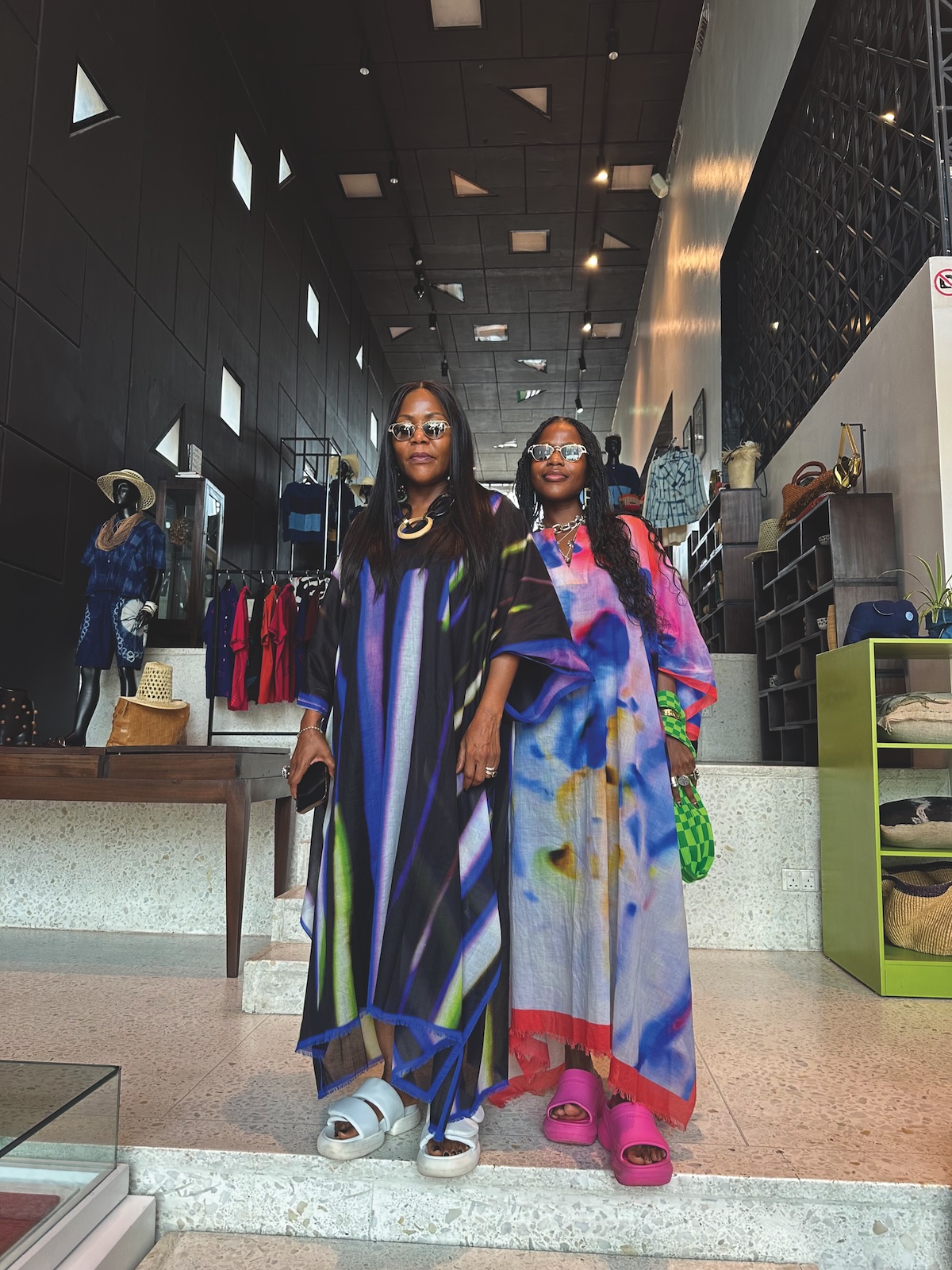

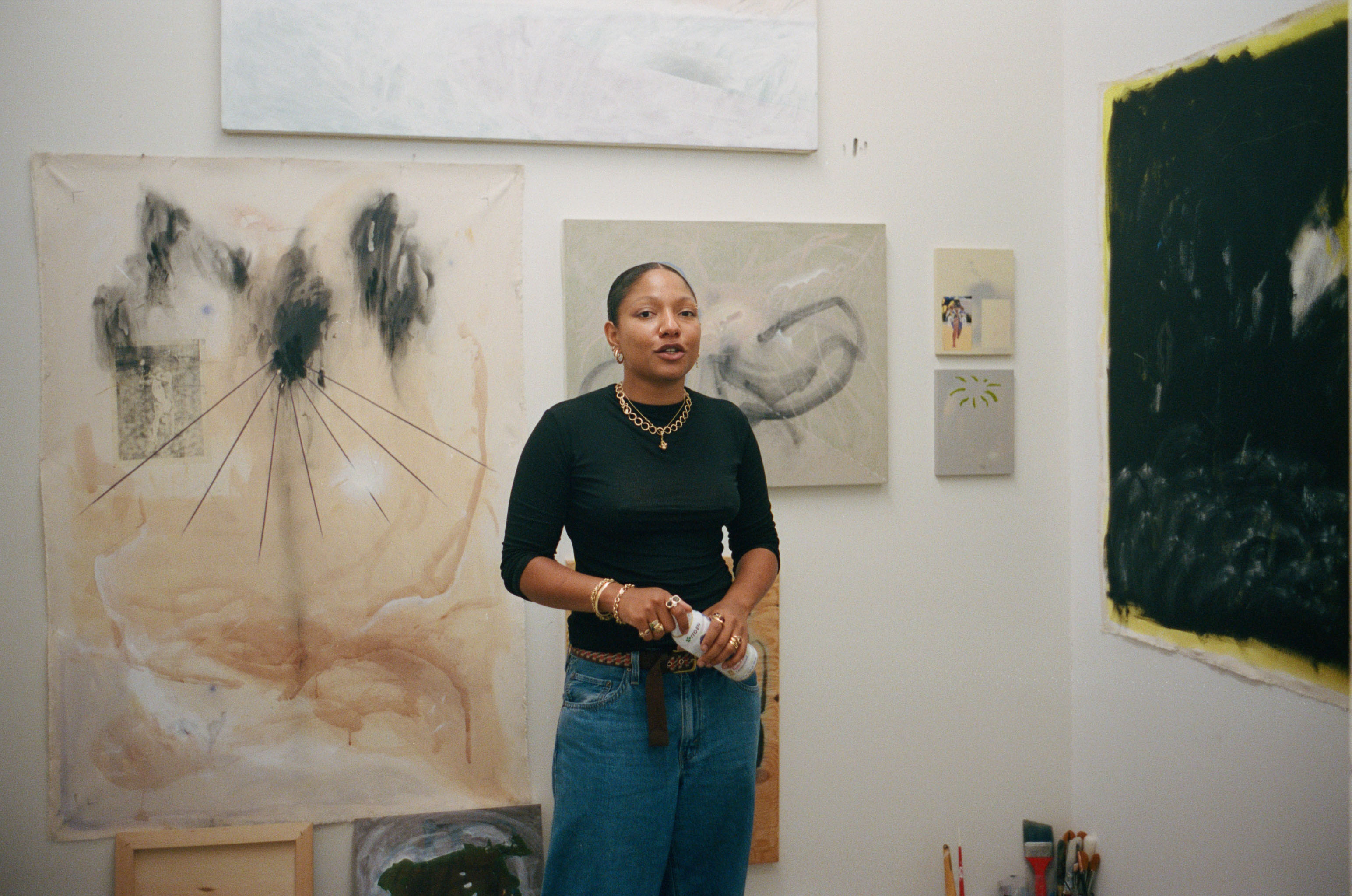
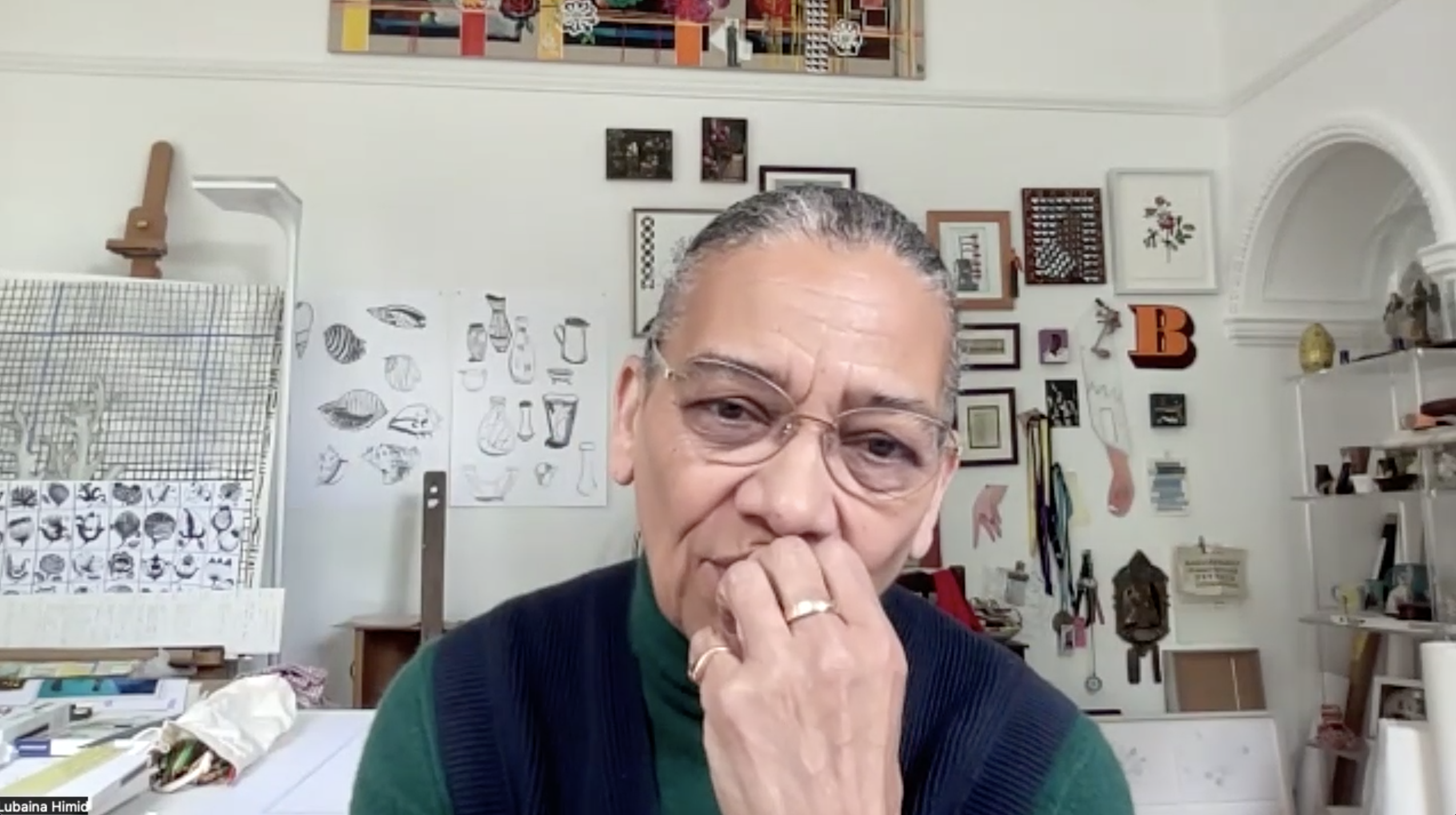

I'm so happy to be on this call. So I'll just introduce myself and the whole thing briefly. I'm Faridah, I'm Nigerian and based in Lagos and London. I'm an independent curator and writer, art historian, all of those things. And in 2022, I decided to start working independently. And the first show that I did was very much inspired by your curatorial pursuits. And the leading question was a quote that I'd read from you, which was, “what are the global realities of black sisterhood?” The show is called manifold, and the first show that we did was in SoHo in London. And I think it was, I want to say, 15 artists, a black women from all over the world. It was meant to be a one off, but it has become kind of an iterative thing, because I think we're all just really happy to have each other, and to have the community. And I think the audience also really enjoyed that sense of community and also contributed to it. So now we're about to do the third one, which is in Lagos in October. And in the meantime, we are working on a zine. We did a zine for the first edition, but I wasn't so happy with how it turned out so I'm re-working that at the moment. I really, really wanted to interview you for the zine, just because you're basically the reason we exist. I sent a very, very speculative email to Hollybush Gardens. And they were so lovely to put us in touch. So thank you!
You have multiple elements of your practice. But thinking about the curatorial side and the artist side, what led you to, first of all, start putting on these shows? And how do you reconcile that with your artistic practice?
Well I suppose the curatorial work is something I do occasionally. And it's something I do when I feel like it. Something I do when I think, no one else is doing this thing, I'm gonna do it. So, in a sense, that's different from what I would call a proper curator. What I'm doing in a way, is making exhibitions with people, in the same way that I make exhibitions that are mine. And in the beginning, we were doing it in a very lo-fi way. Marlene Smith was doing it. I was doing it. And of course, the Black ART group, with Marlene Smith, Claudette Johnson, Eddie Chambers, Keith Piper, were doing it. So it wasn't an unusual thing to do. We didn't call ourselves curators, we were just driven by working with particular artists we wanted to work with, and seeing what they were making and putting our own work in to say “let's have a conversation between my work and your work.” And even now, that is the model. It's just that more people, perhaps, have asked me to do it. But I still wouldn't do it unless I can see a way that conversation can still go on between the artists. And it doesn't have to be the kind of conversation where the artists all agree with each other and want to do the same thing. Whatever it was I said, the word sisterhood would be much too firm or solid a word for what I was trying to do in the beginning. The women I was working with in the Thin Black Line were so different from each other. And their practices are so different, where they lived was different, how they lived was different, where they came from was so different. But I recognized in all of them, and I suppose 40 years later, the fact that we have Turner prizes, and Golden Lions, and you know, all that stuff, means that I was right. I recognized that kind of energy and ambition, not for themselves, because that's what I'm never looking for. But I'm always looking for an ambition for the work. So the artists I'm interested in working with, are the ones that say, I’m making work like this, but I really want to make work that I think might be like that. And those are the conversations, rather than I want to win the Turner Prize, or I want to show at the Serpentine or I want my work to make a lot of money, because I can't help in any of those ways. I can only work with somebody who actually has this crazy idea and wants some help in knowing how on earth (in the idea sort of way) they're possibly going to make it happen. So, finally, to answer your question, if you work curatorially that way, it’s easy to combine that with making because that's what making is about. It’s not really very different.
When you're curating, do you begin a show knowing what types of works you want from the artist? Or is it a more collaborative process that comes out of many conversations and exchanges of ideas?
I made an exhibition in 2015 with Ingrid Pollard, Helen Cammock, and Claudette Johnson, and Claudette Johnson hadn't been showing work for maybe 20 years. But I've known her all that time, you know, and talked to her and met her and all the rest of it. Ingrid Pollard I was in quite a lot of contact with all the time and Helen Cammock was a new artist to me, but I'd seen her work at the Brighton Festival. And I thought, what an interesting idea to try to see what conversations Ingrid Pollard, who's also a filmmaker as well as a photographer, might have with Helen Cammock, who's a photographer/filmmaker. How interesting for those two to be talking to Claudette about showing some new work even though she hadn't been showing work for 20 years or so. And I thought that would be a really nice atmosphere to spend a year and a half, talking and meeting and having cups of tea and being in each other's houses and trying to see how that might work. And that project, in a sense, was what happens at the meetings in between. And then in 2015, I put on that show with Hollybush Gardens who represent me as you know, because in 2014, Lisa Panting said to me, “sometimes the artists in our gallery come to us with a project, have you got a project?” and I knew exactly what that project would be because I wanted Claudette Johnson to feel able to make work and show it again. And I thought Helen Cammock needed to be talking to artists who are not that much older than her, but much further on in their careers in different ways. So I was trying to do something that was not entirely about an exhibition.
So even now, whether it's the big show with the Arts Council with 40 artists, the one at Home, which was about Manchester, the one at Hollybush Gardens, which was about conversations about just being artists. It is more about oh, this might be an interesting conversation, and I know I can make it an exhibition experience. I'm not interested in making it a book to see or a book on the wall. I'm interested in making an experience for an audience that they're kind of moved by either intellectually or emotionally in that room, in that space, at that time.
Based on what you just said, that kind of experiential approach to exhibition-making, how do you feel about the way in which your exhibitions have taken on this mythical status? Where people that didn’t experience them still know about them
Well, I have to say, it's extraordinary what's happened. I suppose it's because the show perhaps had more of an agenda for me than I ever thought at the time. At the time it's just this is a great idea, can I persuade these people in the middle of the city to do this exhibition? They (ICA) boasted for the previous 40 years that they are the cutting edge of British art. How cutting edge are they? Will they put on a show with very, very young black women? I was about 30. But people like Marlene and Sonia (Boyce) were maybe 24/25. Ingrid, me and Veronica (Ryan) were all about 30. Of course, I was 30. So I felt old. But now that I'm 70, nearly, I have realized that 30 is the beginning of things. Whereas I was thinking 30, blimey, I better do this before I can't do this kind of work anymore. You know, while I've got the energy for it. And, we did it on no money, nobody paid us to do it. Friends of mine could hire a van and so they picked up the work from the artists, the artists had no money. It was very much an amateur thing, you know. And of course, I don't think I realized how much of an amateur thing it was because people in the following decades have said to me “have you got any photographs?” And I say only Ingrid Pollard even had a camera! None of us had phones. Some people didn't even have landlines in their houses because they didn't have the money to pay the bills for that. So only Ingrid Pollard had a camera. And she was an artist and a documentary photographer, but she wasn't taking images of the exhibition in that documentary way. So people now say “have you got any high definition photos of the Thin Black Line?” (Laughs) I say: There’s these four photos that are knocking around, that's all I've got and Ingrid took them all!
So we never were thinking it was going to take on any kind of iconic status. A guy called Waldemar Januszczak wrote a review and he just hated it. He said it was bad, it was noisy. It wasn’t noisy, it just had a lot of work in it, with eleven women squashed in a corridor. But that was the point. And so he's just rude, really. And that was all that got written about it. A lot of people saw it. And a lot of friends of ours, relatives of ours, other artists saw it. And a lot of art world people saw it because it was in the corridor on the way from the foyer to the bar. And in those days all those kinds of art people, like Nick Serota, hung out there. So they saw it, but they didn't take it in until much much later. So yeah, it's a real surprise to me, because the putting together of it was like herding cats. (Laughs)
And a practical question, how were your shows in the 80s funded?
I just borrowed money from people. I was working as a waitress sometimes. I was a community worker. I lived in my friend's house who didn't charge me any rent. It was 40 years ago so things were not expensive like they are now, you know? And so I'd say, could you borrow a van? And she'd say, yeah, and she would pick up the stuff. So it wasn't, it just wasn't funded. There weren't grants. And the galleries themselves, Africa Center, Battersea Arts Center, and the ICA were not giving us money to show either, because that wasn't a thing. So it was just funded with whatever we could. We really wanted to show but I don't think any of us really knew how the thing worked. And I think that the strength of it, and the weakness of it. The strength of it in that when you don't know anything, you do what you like. And the weakness in that if you don't know how to follow it up, then there's a danger of it disappearing.
I was thinking about how multidisciplinary your practice is. Generally, every time I see your work, I feel like you're doing and saying something different especially when it comes to the mediums you use. Was there any point where you felt pressure to streamline or focus on one medium?
I had this real advantage of being trained at Wimbledon Art school as a theater designer. So I was never trained as a painter, or printmaker or a photographer. So, that kind of streamlining, that one line of business approach, was never an option. I never understood creative practice in that way. So 40/50 years ago, when I was at Wimbledon, I would be designing a set, on paper, for Rigoletto or some opera, but then I would also have to draw the costumes. And then I might have to make the costumes. And then I might have to make the set and the furniture or paint the great big backdrop or decide how the lighting was going to be. And when you're doing theater, you're working with a director, and the director might decide that he wants to set Rigoletto in a coffee bar in Manhattan in 1950, instead of in the time that Rigoletto was. So all the time you’re looking at different kinds of books, different costumes, different places. It's all about gathering visual material from everywhere, and making it work. That's how my brain and my creative training was, and I just never let it go. So to me, a painting is not above a work on paper, which is not below a painting in a drawer. It’s just about what I feel like doing at the minute. And I think because in those years, when no one was taking all that much notice of what any of us were doing, the years between 1989, just before from Two Worlds at the Hayward Gallery, and something like 2000, I was making whatever I wanted to make. I was showing it in different sorts of places, but no one important was taking all that much notice. So you then get into another habit of doing whatever you like, and then that's a hard habit to break.
Have you felt that kind of pressure in any way post–Turner Prize?
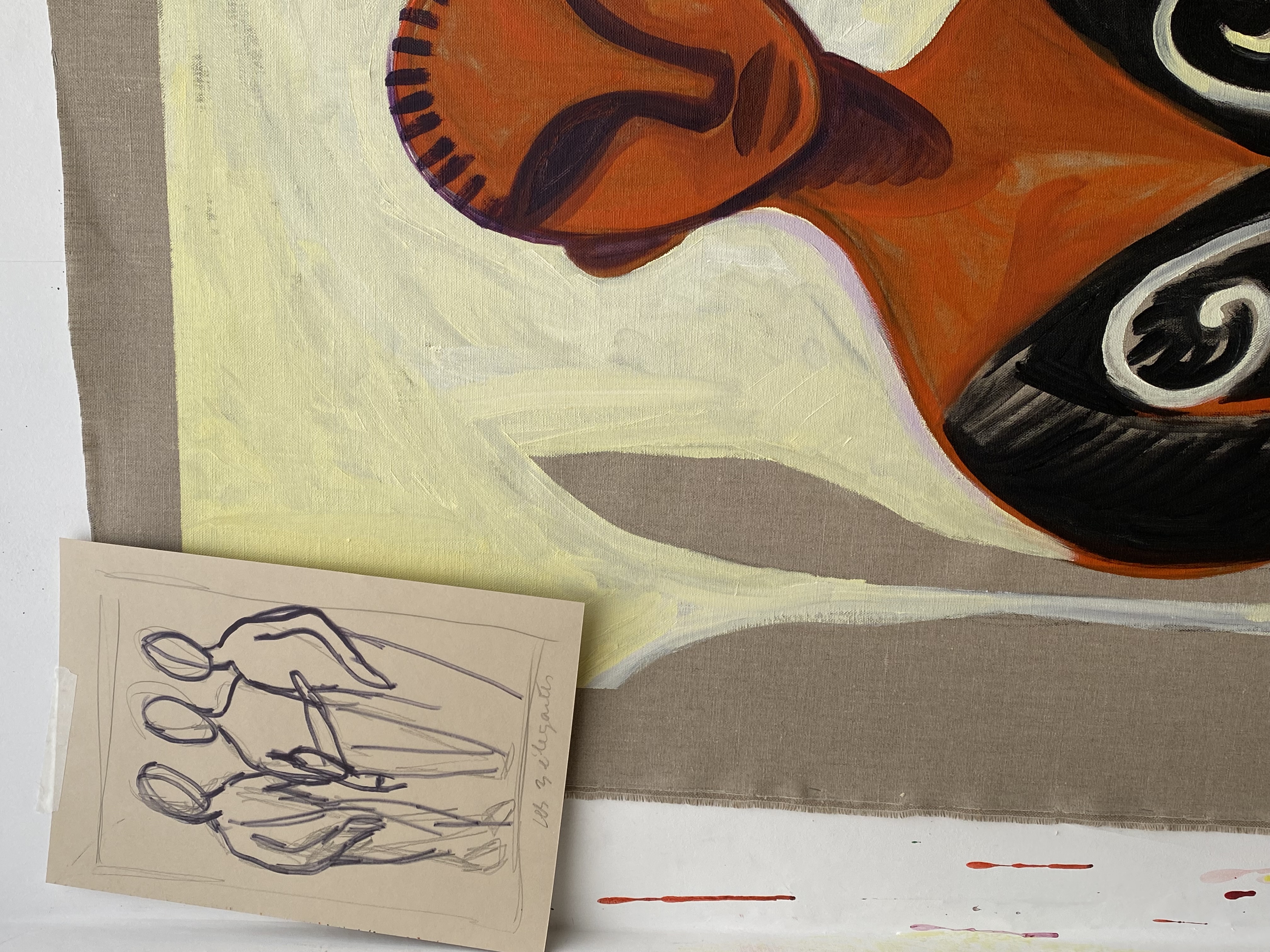
Well I feel it, because there's one set of people that want rectangular paintings on canvas of black people. That's what they want. Then there are another set of people who want a man in a drawer. Because that's what they want. Sometimes, that's absolutely what I want to paint. At the moment, I have a show at Greene Naftali in New York, which is called Street Sellers. And I've always been interested in people selling things on the street, way back to London in the 1600s. I'm just interested in how a human being makes themselves into a shop, and sells flowers or fish or milk or chairs or whatever. But for an exhibition that I have in Austin in Texas, one of the bodies of work is 64 planks, which are maybe 4 meters high. And these 64 planks are called The Aunties, because to me, they are all the women that I've become, or that were around in my house when I was young or around in everybody's house when they were younger. But there's no actual black body in that work. And, you know, quite often I'm making drawings of boats and that's what I really want to make a lot of the time as well. But less people want to buy those things. But you know, something? I don't care. I'm well aware of it. But I personally cannot summon up a scene with people in it when I can't do it. It’s like no actually, today, I just want to paint some old sailing ships or I want to draw some 14th century beehives. I just want to do it. But there is a pressure. It's lurking and looming there. I think people know it, but they don't care, that artists can only do what we can do. You can churn it out, I suppose but I think it looks churned out and it looks formulaic. I've looked at so much art for so long, that I can tell if mine's looking formulaic. I could look at it and think well, if Claudette Johnson made this, is it any good? And when you look at someone like Claudette’s work, it has a presence that probably no one else’s has, just a presence and a sense of self. And it's because she makes the work she makes because that's what she wants to make. You couldn't get her to make work that she just didn't want to do. So the pressure is there, but we’re resisting it.
The idea of women talking to each other and being open feels very central to what Manifold is. Sometimes the dinner is more important than the show because it's when everyone comes together and can talk very freely. How important is that sense of community to you?
I think it’s important. If it works, then I'm really happy about that. For people to then go off and maybe do things together that don't need me. That’s really what it's about. But I think it's hard to define because I think, although I absolutely know I could pick up the phone, to maybe at least 30 women artists probably and have a conversation, I'd be hesitant to say that it was a community. We feel a sense of belonging to each other because we did some very important thing together either once or twice or five times. But I always want people to feel really free to not ever do that again. And to think okay, that was really useful that time, but now I don't want to do it. And I think Veronica Ryan is a case in point there. You know, she was in Five Black Women at the Africa Center, in Black Woman Time Now at Battersea Arts Center and in The Thin Black Line. But then after that, it wasn't useful to her anymore. She had a practice already and she was known in more sculptural circles if you like, and she didn't want to be entangled in a more political set of conversations. She wanted to get back to the difference between this kind of marble and that kind of marble or this shape or another shape. And in a way, that's the very reason that her work attracted me in the first place, that she was passionate about making and about materials. So for me, although it hurts a little bit, because I think she's a great artist, I understood how those shows were useful, and then they were not useful. And that was the point.
What work is there still to do?
Well, I think it is really important for young artists to be building a sustainable practice that may well have grown out of conversations with other women, with other black women. But you don't see Edmund de Waal, Antony Gormley, Damien Hirst, Grayson Perry, sitting around having a cocktail together, trying to work out what to do next. I think we need to understand who are friends and supporters and safe people to have exchanges with. But if we're ever going to change this northern European art world, we’re going to have to concentrate on what we're making, more than feeling safe. But until we can feel safe, that's a hard thing to do. You have to have the balance between the two things, really. And I think audiences are very important to all of us. To make work that no one like us is ever going to look at, I think that would be sad. If people who we talk to in the everyday, or who mean something to us or relate to us, never ever saw that work because it was only in places that they were not interested in going to, that would be really a pity. So we're trying to do something. We're trying to break something and mend it again more in our shape. I think it's very important to keep doing it, but as artists, it's hard to do more than make your art. So make your art and see if you can get the art to do the talking. You know? It's not easy. In some ways, I think, oh, you know, if I could just keep going another 70 years, I'm sure I could solve it (laughs). But I think lots and lots of people like yourself, like other groups of artists and curators all over the world took bits and bobs of whatever, Black Audio Film Collective were doing or Sankofa were doing or BLK Art Group were doing. They took the bits they wanted, and are now running with it. That was the point. The point was to change things in the long term.
