

What is your current relationship to multidisciplinarity?
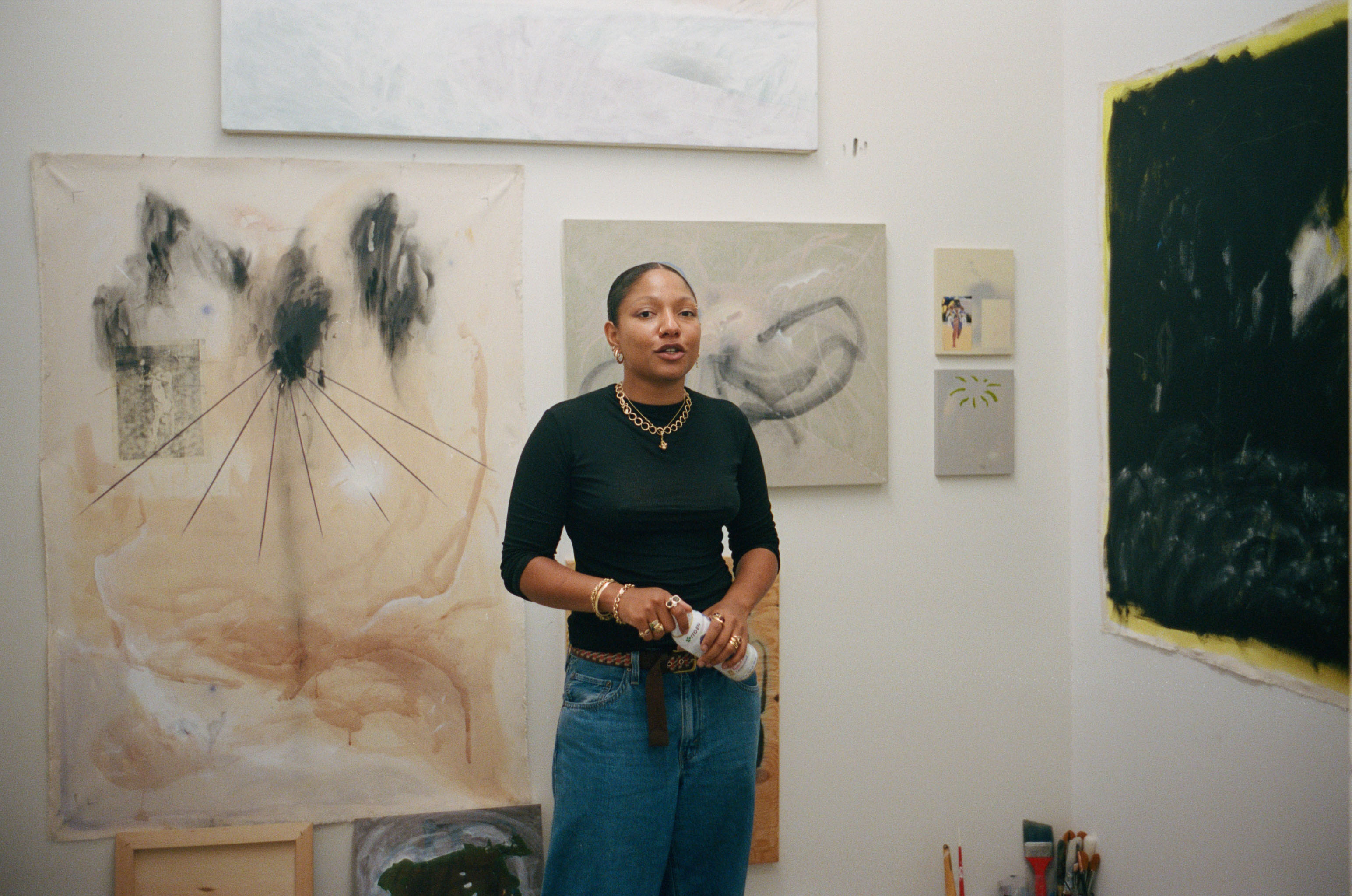
I think, right now, I'm trying to accept myself, for who I am, and how I choose to express and I'm trying to not overthink it. I feel like since I started practising professionally, I have been having an internal battle, with overthinking every single thing I do, because I'm very aware that I'm being observed. And my work is going to be observed and people are going to create opinions and their own narrative of it. And I feel like, maybe because the process of being an artist is so personal, and it's actually a very vulnerable thing for me to be doing. Being an artist, and making paintings feels like taking a huge risk. And so because of that, I feel like I try to mitigate the risks by controlling everything, and controlling how people are going to perceive me, and trying to control my image as an artist. And I realised that that was wrong, because the very thing I was trying to protect, I was destroying, which was the journey. And the process of making work became super painful to do. So then it was almost like there was no point, which then led to the spiralling out of control, because what am I even doing anymore? Like, I don't even enjoy what I'm doing. So what's the point of protecting it? It was getting a bit weird. But I think now I feel like I'm on the path towards acceptance, that there is no one way that I can define myself. And I don't need to arrange myself neatly for people to be able to understand me. But I'm really trying to separate the critique from the process. So I've given myself rules, now I'm just trying to make work without thinking. And I can think once the work is done. I wouldn't say that now work is so enjoyable or I'm so happy to make work, but I have so many more moments of being in the flow. So a lot more moments of enjoying what I'm doing and feeling like I'm doing the right thing, like I'm in the right space at the right time. And in terms of mediums, I think I'm just naturally curious. And it's not that I feel like, oh, I'm done with oil paints, or I'm done with watercolour or whatever. But I feel drawn to different curiosities. Like, I know, eventually, I'm going to have an era where I'm working more three-dimensionally with furniture. But this just feels like my small paper work and textile moment. It feels like the right thing for me to be doing. And I'm proud of myself for doing it now.
Looking at the pictures it feels like there was such a transition for you between the first Manifold and Manifold Deluxe. With Manifold Deluxe you had this last minute surge where you were like, I have to make works on paper.
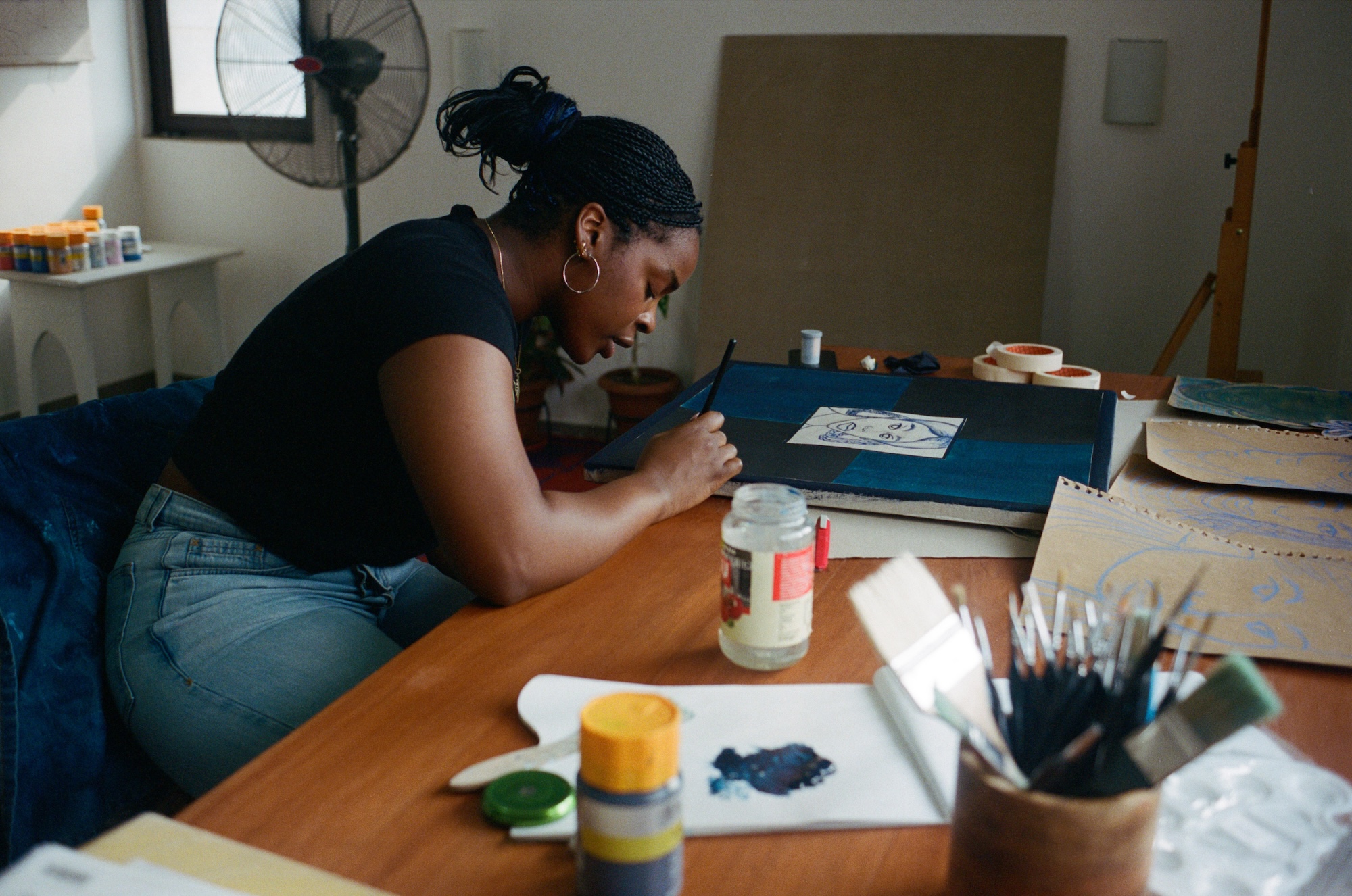
Spiritual emergency (laughs)! Oh, my God, that's so true. That was the beginning! I was like I have to get out of this. Like I need to get out of this weird canvas world. I genuinely think for me, my home will always be small paper works because that's where I started. I was working at my desk, I didn't have a studio, it's where I'm most comfortable. I can paint anywhere. They're so tiny, and very immediate. And it feels like my most honest work because it's so immediate. I think when I started making the bigger oil on canvas paintings, I felt like I was trying to prove something. I was trying to prove that I can paint. Although I think the works are really powerful, and I'm not discounting the works. I think it just wasn't all about me. So I think I realised I hated that (laughs). I just didn't feel good making work anymore. And if I'm being totally honest, you know how people always say you need to be outside your comfort zone and push yourself. It was definitely that for me. But I realised that I actually like being in my comfort zone with painting. I think painting should feel comfortable for me. I don't think I'm the kind of artist that needs to feel constantly challenged and uncomfortable when I'm making work. I like to feel curious and like I'm exploring but I don't like to feel uncomfortable making work and it was actually physically uncomfortable. When I think back to making the locket for the first Manifold, I think about the physical pain I was in. Like, not just the emotional and spiritual pain. And I think I just have to accept my limits. I think that's also important as a human being to know your limit. I don't think I was in a good place when I was doing Manifold Deluxe. But I feel like that's why paper works are so powerful for me, because I think the works came out really really well, some of my best paintings I’ve ever made were in Manifold Deluxe. And I was going through it.
I feel like the way you came to your painting practice was also trying to find a release from the other stuff in your life. So the fact that painting became the other stuff. I have that thing as well, where I don’t really find going to shows as fun anymore, and that used to be the funnest thing in my life. So it’s like that weird thing where the thing you enjoy becomes work.
Do you think that this is something that we need to be mature about and figure out limits on those things so we don't ruin them? I feel like I ruined painting for myself because I wasn't doing it in a mature way. I wasn't putting any limits, and so I made it horrible. I'm slowly learning how to have limits with my work. And I'm slowly starting to enjoy my work again. I was seriously considering quitting. So maybe it's also about figuring out a way to like, have healthy restrictions on how you interact with exhibitions for you or for me, having a distance from my practice.
Your work has always had a very specific relationship to symbolism, which we talk about all the time. And now you’re working with textiles and adire, which also has its own relationship to symbols. Can you tell me about your journey into working with textiles?
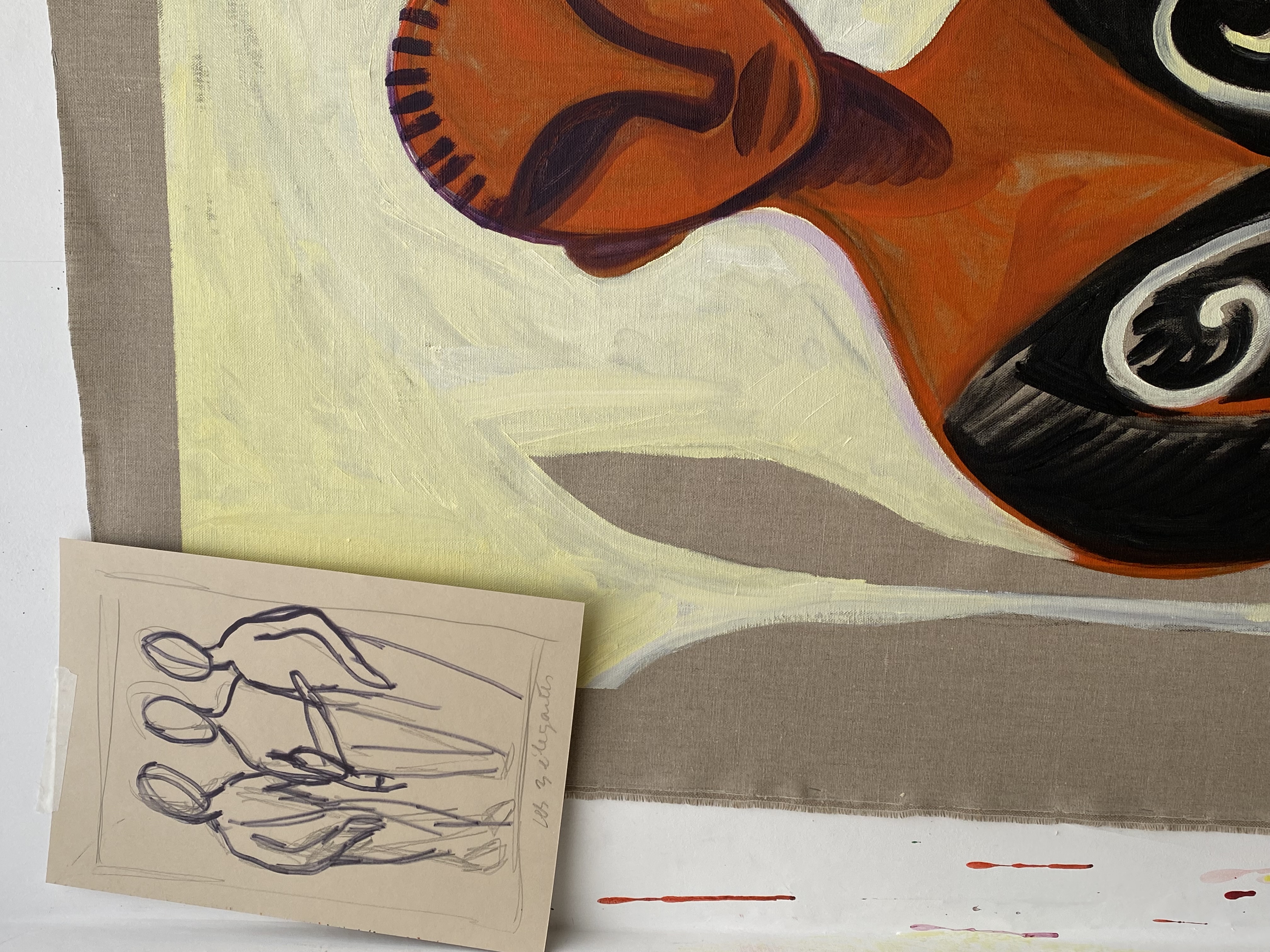
I'm always seeing symbols and patterns every day, and I have been trying, consciously and subconsciously, to create some sort of taxonomy of things in my work, my own visual language. And now that I've been doing adire, I've been reading about it as well. I think it's actually so powerful that there is an art form that is specifically made and invented by Yoruba women. I just think that's so cool; they are traditional painters, and they're women specifically. I feel very connected to making this type of work and I feel like I'm continuing a narrative that is more historically meaningful than even the paintings. And I hope that I can add something to the craft, hopefully, eventually. I’ve been reading about how the women were also trying to create their own language with the different symbols. So for example, there was the circular spiral, which started as a snail, which I think was supposed to mean circle of life. Then there's a square spiral that's supposed to mean long life. So I'm figuring out if it's possible for me to start creating my own symbols that draw on the repeated motifs that I'm seeing and add to them. But this is something that I feel will happen slowly, because I'm trying not to think too much. But I think it's coming together.
Tell me about the spirals in your work.
I first started drawing spirals only because it was quite a literal representation of how I was feeling which was lost, confused, angry, frazzled. As we said, there was a spiritual emergency, and it was coming out in spirals. I feel like it's been a time where I've been transitioning, making a lot of new habits, letting go of old habits, and it felt like a very, very, very painful journey. And I found it very very satisfying just painting those lines round and round and round because that's how I felt. But then thinking about the meaning behind spirals, I do feel like we’re always on some sort of soul journey. And now I'm trying to conspire with myself, instead of just letting my life happen, I’m trying to be more present in the changes that are happening in my life. I was talking with my friend about spirals and how, depending on how you look at it, it could be a journey within, or a journey outward. And I feel like those are both important things that I'm trying to do in my life, not even just in my practice. And then also thinking about how you might think that you're not making progress when you're spiralling. We always use the phrase “I'm spiralling right now”, but you could be spiralling upwards, depending on how you look at it. And it might feel like you're going round and round, but you might be going round and up at the same time. And there was this quote I saw from CS Lewis, from A Grief Observed where his wife passes away. And he writes this book about himself and about observing himself going through grief. And there's a quote from the book and it says, “For in grief, nothing stays put, one keeps on emerging from a phase, but it always recurs round and round, everything repeats. Am I going in circles, or dare I hope I am on a spiral? But if a spiral, am I going up or down it? How often—will it be for always? How often will the vast emptiness astonish me like a complete novelty and make me say, ‘I never realised my loss till this moment’? The same leg is cut off time after time.”
So it's kind of dark. But I think, understanding like the distinction between am I going in circles or am I actually on a spiral? I feel like the spiral also represents acceptance, because there is no beginning or end. When you're on that spiral journey, no matter if you're making progress, you kind of have to accept that this is it.
What does Manifold mean to you?
I think Manifold means community for me. It kind of feels like Sisterhood of the Travelling Pants. You get to feel like you're all growing together, you get to cheer each other on. It feels like community, sisterhood. And it also feels like a really important moment in time that I think years from now it's going to be epic that this group of women kept on meeting. I feel very lucky to be a part of it. I think we were also probably surprised by what came out of that Instagram. I think maybe people would have assumed that it would become like a portfolio of sorts. But I love the fact that it became a meme account, and essentially people just complaining and then like every now and then showing support for one another. It's nice to feel like you're not screaming in a void. Like it's nice to know that somebody heard you screaming and they’re screaming right next to you. We’re all yelling and screaming and throwing up together. So that's really cool.
